
This blog provides a meditation on the Episcopal daily readings along with a headline from world news:
Hans Kung urges Catholic revolution to unseat the Pope and reform church
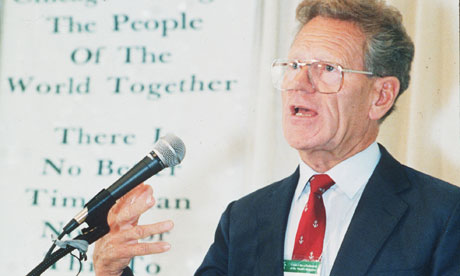
Hans Kung, Theologian
Acts 22:17-29
Paul Sent to the Gentiles
17 ‘After I had returned to Jerusalem and while I was praying in the temple, I fell into a trance18and saw Jesus* saying to me, “Hurry and get out of Jerusalem quickly, because they will not accept your testimony about me.”19And I said, “Lord, they themselves know that in every synagogue I imprisoned and beat those who believed in you.20And while the blood of your witness Stephen was shed, I myself was standing by, approving and keeping the coats of those who killed him.”21Then he said to me, “Go, for I will send you far away to the Gentiles.” ’<!– 22 –>
Paul and the Roman Tribune
22 Up to this point they listened to him, but then they shouted, ‘Away with such a fellow from the earth! For he should not be allowed to live.’23And while they were shouting, throwing off their cloaks, and tossing dust into the air,24the tribune directed that he was to be brought into the barracks, and ordered him to be examined by flogging, to find out the reason for this outcry against him.25But when they had tied him up with thongs,* Paul said to the centurion who was standing by, ‘Is it legal for you to flog a Roman citizen who is uncondemned?’26When the centurion heard that, he went to the tribune and said to him, ‘What are you about to do? This man is a Roman citizen.’27The tribune came and asked Paul,* ‘Tell me, are you a Roman citizen?’ And he said, ‘Yes.’28The tribune answered, ‘It cost me a large sum of money to get my citizenship.’ Paul said, ‘But I was born a citizen.’29Immediately those who were about to examine him drew back from him; and the tribune also was afraid, for he realized that Paul was a Roman citizen and that he had bound him.
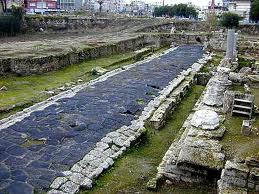
Roman Road in Tarsus
Luke makes the point that his hero is rejected by his compatriots but respected by the officials of Rome, because he is a citzen of Rome with full rights. Roman citizenship was eagerly sought by most of those who lived in the Empire. It could be purchased or earned by some special service to the Empire. It could also be conferred as a reward-and in fact we are told that the Roman general Pompeius conferred it on the people of Tarsus, Paul’s native city, for help given by them. Whether this is the source of Paul’s alleged R oman citizenship we do not know. Paul never refers to himself in this way, and it’s doubtful if any special status for Tarsans would have counted for much so long after the time of Pompeius. But Luke uses it in his story as a dramatic coup: the accused missionary, despised by his own Jewish establishment, is actually a citizen of Rome itself! He is no enemy of Rome but a law-abiding citizen who asks for the protection of Roman Law. This is the picture Luke wants to show of the Apostle: as a leader of a Church which is itself law-abiding, and deserving of protection by imperial law, as it carries its peaceful message of a kingdom greater than Rome across the territory of the Empire. Of course, sooner or later the inherent contradiction of such peaceful revolution was bound to surface, as it did increasingly in Luke’s time, when Roman Emperors realised the extent of Christian belief within Rome. The challenge of the “rule of God” to the rule of the Emperor became all too obvious. But it would seem that the Church had followed Luke’s lead in living peacefully under the Law and respecting the government of the Empire. Long-learned Jewish skills of survival within great empires (Joseph, Daniel) stood the disciples of Messiah Jesus in good stead, while not compromising their allegiance to God’s rule. When confronted with the choice of Caesar or Christ, many Christians were ready to accept the consequences of choosing Christ. Through his picture of Paul, Luke is helping to build the strategy of the Christian community in its long and sacrificial engagement with the Roman Empire.
It has much to teach those of us who are citizens of the Empire of World Capitalism today.
Luke 6:27-38
Love for Enemies
27 ‘But I say to you that listen, Love your enemies, do good to those who hate you,28bless those who curse you, pray for those who abuse you.29If anyone strikes you on the cheek, offer the other also; and from anyone who takes away your coat do not withhold even your shirt.30Give to everyone who begs from you; and if anyone takes away your goods, do not ask for them again.31Do to others as you would have them do to you.
32 ‘If you love those who love you, what credit is that to you? For even sinners love those who love them.33If you do good to those who do good to you, what credit is that to you? For even sinners do the same.34If you lend to those from whom you hope to receive, what credit is that to you? Even sinners lend to sinners, to receive as much again.35But love your enemies, do good, and lend, expecting nothing in return.* Your reward will be great, and you will be children of the Most High; for he is kind to the ungrateful and the wicked.36Be merciful, just as your Father is merciful.
Judging Others
37 ‘Do not judge, and you will not be judged; do not condemn, and you will not be condemned. Forgive, and you will be forgiven;38give, and it will be given to you. A good measure, pressed down, shaken together, running over, will be put into your lap; for the measure you give will be the measure you get back.’

Gandhi’s text
No other man has ever spoken like this. These words leave the ethical philosophies of Plato and Aristotle, not to mention those of Hobbes and Locke and Mill and all the moderns, looking timid and childish. The “golden rule” (Do unto others etc) had been enunciated by Confucius amongst others, usually in the negative form. But only Jesus realised that its rigorous application meant showing love for enemies. Clearly this love is not a sentiment. It is a determination to seek the enemy’s good as well as one’s own. Gandhi recognised the extraordinary force of this, not only as a tactic, as is sometimes alleged, but as a commitment in conflict. Only an unwavering search for the enemy’s good could prevent the eye-for-an-eye which “leaves the whole world blind.”
Jesus ‘examples of conflict, drawn from a conquered society where casual insult and violence were common, show that he was not envisaging ideal circumstances but the difficult reality in which his hearers lived. We see that for Jesus this peacefulness does not proceed from a teeth-clenched pacifism but from a huge generosity of heart which is capable also of giving without return. This in turn derives from the generosity of God, whose kindly rule encompasses all creatures. The ethical aim is for human beings to “become what they are”, that is. children of the Most High. Nothing less than the highest they know is to be the model for their behaviour.
This is stunningly evident in the command not to judge. Surely those who live by the very highest standards have the right to judge? No, says Jesus, because the Highest, the one he calls Father, does not judge but is merciful. There is a secret equivalence between what people give and what they receive. Those who have schooled themselves to the generous love of enemies, the care of the needy and forgiveness of those who harm them, find that God’s bounty is poured into their lap. Worldly people might not notice this bounty, but it’s as real as a milk-shake. (verse 38)
This teaching is as good a proof of Jesus’ divinity as you can find.
 Emmock's Blog