
This blog provides a meditation on the Episcopal daily readings along with a headline from world news:
Palestinian Christians protest against Israeli wall of exclusion:
The Acts 23: 12-24

Mass at Beit Jala
12 In the morning the Jews joined in a conspiracy and bound themselves by an oath neither to eat nor drink until they had killed Paul.13There were more than forty who joined in this conspiracy.14They went to the chief priests and elders and said, ‘We have strictly bound ourselves by an oath to taste no food until we have killed Paul.15Now then, you and the council must notify the tribune to bring him down to you, on the pretext that you want to make a more thorough examination of his case. And we are ready to do away with him before he arrives.’
16 Now the son of Paul’s sister heard about the ambush; so he went and gained entrance to the barracks and told Paul.17Paul called one of the centurions and said, ‘Take this young man to the tribune, for he has something to report to him.’18So he took him, brought him to the tribune, and said, ‘The prisoner Paul called me and asked me to bring this young man to you; he has something to tell you.’19The tribune took him by the hand, drew him aside privately, and asked, ‘What is it that you have to report to me?’20He answered, ‘The Jews have agreed to ask you to bring Paul down to the council tomorrow, as though they were going to inquire more thoroughly into his case.21But do not be persuaded by them, for more than forty of their men are lying in ambush for him. They have bound themselves by an oath neither to eat nor drink until they kill him. They are ready now and are waiting for your consent.’22So the tribune dismissed the young man, ordering him, ‘Tell no one that you have informed me of this.’
Paul Sent to Felix the Governor
23 Then he summoned two of the centurions and said, ‘Get ready to leave by nine o’clock tonight for Caesarea with two hundred soldiers, seventy horsemen, and two hundred spearmen.24Also provide mounts for Paul to ride, and take him safely to Felix the governor.’
It’s good to remember that Luke is writing around AD 90 about events which took place around AD 50. We do not know what sources he had, but we do know how he treated one of his sources for the life of Jesus, namely the Gospel of Mark which he used with considerable freedom. We also know that ancient historians felt free both to alter sources and to invent where information was lacking. For all these reasons, we have to take the Gospels and The Acts as witnesses first of all to the time of their composition and to the Christian communities for which they were produced, rather than for the facts of Jesus’ life or of the life of St. Paul. Of course there are facts about Jesus and Paul embedded in the naratives, but these have to be established by painstaking research.
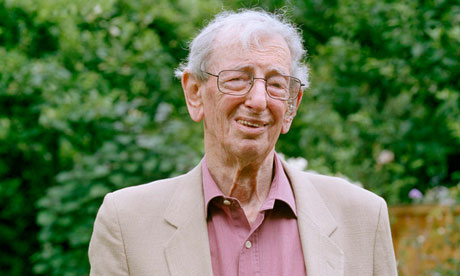
the late Eric Hobsbawm
In the case of the persecution of Paul by the Jewish authorities, most scholars are unsure if Luke’s narrative is much more than elaboration of a dimly remembered antagonism, given point and purpose by the antagonism between church and synagogue in Luke’s time, and by Luke’s desire to paint Christainity as peaceful and Judaism as lawless, in the hope that contemporary Roman officials would take as reasonable an attitude to Christianity as they are reported to have taken towards Paul.
The great historian Eric Hobsbawm who died recently taught us to view historical narrative with scepticism. We should always ask, “Who has written this?”, “For whom was it written?”, and “In whose interest?” Biblical history is no exception. We may agree that Luke’s picture of Jihadi-like behaviour by Jewish thugs is quite convincing and may even remind us of religious thuggery in Israel today, but we should not think that Luke is unbiased, not forget that once Christians gained power, they came top of the religious thuggery league tables for many centuries.
Onthe whole Luke’s stereotypical pictures of Christians and Jews are not helpful for our understanding of either faith.
Luke 7:1-17
Jesus Heals a Centurion’s Servant
7After Jesus* had finished all his sayings in the hearing of the people, he entered Capernaum.2A centurion there had a slave whom he valued highly, and who was ill and close to death.3When he heard about Jesus, he sent some Jewish elders to him, asking him to come and heal his slave.4When they came to Jesus, they appealed to him earnestly, saying, ‘He is worthy of having you do this for him,5for he loves our people, and it is he who built our synagogue for us.’6And Jesus went with them, but when he was not far from the house, the centurion sent friends to say to him, ‘Lord, do not trouble yourself, for I am not worthy to have you come under my roof;7therefore I did not presume to come to you. But only speak the word, and let my servant be healed.8For I also am a man set under authority, with soldiers under me; and I say to one, “Go”, and he goes, and to another, “Come”, and he comes, and to my slave, “Do this”, and the slave does it.’9When Jesus heard this he was amazed at him, and turning to the crowd that followed him, he said, ‘I tell you, not even in Israel have I found such faith.’10When those who had been sent returned to the house, they found the slave in good health.
Jesus Raises the Widow’s Son at Nain
11 Soon afterwards* he went to a town called Nain, and his disciples and a large crowd went with him.12As he approached the gate of the town, a man who had died was being carried out. He was his mother’s only son, and she was a widow; and with her was a large crowd from the town.13When the Lord saw her, he had compassion for her and said to her, ‘Do not weep.’14Then he came forward and touched the bier, and the bearers stood still. And he said, ‘Young man, I say to you, rise!’15The dead man sat up and began to speak, and Jesus* gave him to his mother.16Fear seized all of them; and they glorified God, saying, ‘A great prophet has risen among us!’ and ‘God has looked favourably on his people!’17This word about him spread throughout Judea and all the surrounding country.
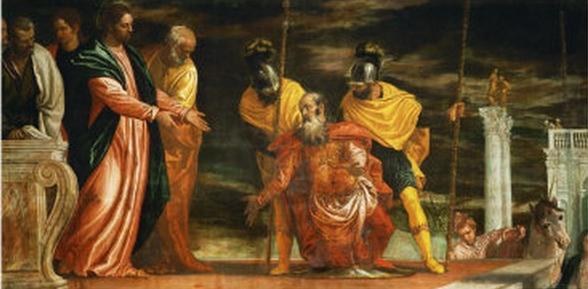
Jesus heals the centurion’s servant
In these stories Luke wants to give the reader a picture of Jesus as the renewer of life, who exercises his healing power for a foreigner and a widow. The stories are also instructive in that Jesus responds to the Centurion but takes the initiative in the case of the widow. Doubtless the centurion expresses Luke’s understanding of Jesus’ healing ministry: it is his obedience to the authority of God which gives him the authority to heal. Perhaps this profound insight was first expressed by a Roman soldier but it is of permanent value: God desires life and health for all his children; the Son of God -and all who follow him-act decisively to implement this desire on earth. The trusting humility of the centurion is a channel for Jesus’ gift of life; but in the case of the dead boy, Jesus creates trust by his act of healing. Jesus’compassion for the situation of a widow now deprived of her only comfort and support in life goes ahead of any expectation.
We are less ready to credit miracle stories than Luke was. So what are we to do with these? The one thing we must not do is to turn them into a theological idea. There were plenty of these going about in Luke’s time but he wants to show the reader that real and unexpected goodness happened through Jesus’ ministry: sick people were cured; others were snatched back to life out of the clutches of death. If Jesus did not really heal people, the tradition about him is worth no more than many a pretty story.
 Emmock's Blog