
This blog provides a meditation on the Episcopal daily readings along with a headline from world news:
Freed Pussy Riot member sticks by her convictions:

Yekaterina Samutseyvich
Acts 25:13-27
Festus Consults King Agrippa
13 After several days had passed, King Agrippa and Bernice arrived at Caesarea to welcome Festus.14Since they were staying there for several days, Festus laid Paul’s case before the king, saying, ‘There is a man here who was left in prison by Felix.15When I was in Jerusalem, the chief priests and the elders of the Jews informed me about him and asked for a sentence against him.16I told them that it was not the custom of the Romans to hand over anyone before the accused had met the accusers face to face and had been given an opportunity to make a defence against the charge.17So when they met here, I lost no time, but on the next day took my seat on the tribunal and ordered the man to be brought.18When the accusers stood up, they did not charge him with any of the crimes* that I was expecting.19Instead they had certain points of disagreement with him about their own religion and about a certain Jesus, who had died, but whom Paul asserted to be alive.20Since I was at a loss how to investigate these questions, I asked whether he wished to go to Jerusalem and be tried there on these charges.*21But when Paul had appealed to be kept in custody for the decision of his Imperial Majesty, I ordered him to be held until I could send him to the emperor.’22Agrippa said to Festus, ‘I would like to hear the man myself.’ ‘Tomorrow’, he said, ‘you will hear him.’
Paul Brought before Agrippa
23 So on the next day Agrippa and Bernice came with great pomp, and they entered the audience hall with the military tribunes and the prominent men of the city. Then Festus gave the order and Paul was brought in.24And Festus said, ‘King Agrippa and all here present with us, you see this man about whom the whole Jewish community petitioned me, both in Jerusalem and here, shouting that he ought not to live any longer.25But I found that he had done nothing deserving death; and when he appealed to his Imperial Majesty, I decided to send him.26But I have nothing definite to write to our sovereign about him. Therefore I have brought him before all of you, and especially before you, King Agrippa, so that, after we have examined him, I may have something to write—27for it seems to me unreasonable to send a prisoner without indicating the charges against him.’

Nero: Roman Emperor in the last years of Paul’s life
Luke’s purpose here is twofold:
1. To continue the parallelism between the story of Jesus’ trial and that of Paul, by introducing into the latter a partnership of Roman official and Herodian King (Agrippa) similar to that of Pilate and King Herod in the the former. Paul is carrying on the ministry of Jesus in his commitment to the good news and his siuffering for it. The great modern hymn writer Brian Wren says we “find our freedom at the mark of nails.” Luke is saying just this about Paul.
2. To set up the Roman and the monarch as witnesses of Paul’s innocence: he is not a trouble- maker; his accusers are. Respect for the civil law was an important characteristic of early mainstream Christianity, although more dissident attitudes to the Empire were also present in some churches. The book of the Revelation, for example depicts Rome as the “Great Whore who sits on the waters”, and as “Babylon the Great.” Persecution of Christians by the state ushered in an era in which Luke’s respect for Roman rule would look mistaken.
Luke 8:16-25
A Lamp under a Jar
16 ‘No one after lighting a lamp hides it under a jar, or puts it under a bed, but puts it on a lampstand, so that those who enter may see the light.17For nothing is hidden that will not be disclosed, nor is anything secret that will not become known and come to light.18Then pay attention to how you listen; for to those who have, more will be given; and from those who do not have, even what they seem to have will be taken away.’
The True Kindred of Jesus
19 Then his mother and his brothers came to him, but they could not reach him because of the crowd.20And he was told, ‘Your mother and your brothers are standing outside, wanting to see you.’21But he said to them, ‘My mother and my brothers are those who hear the word of God and do it.’
Jesus Calms a Storm
22 One day he got into a boat with his disciples, and he said to them, ‘Let us go across to the other side of the lake.’ So they put out,23and while they were sailing he fell asleep. A gale swept down on the lake, and the boat was filling with water, and they were in danger.24They went to him and woke him up, shouting, ‘Master, Master, we are perishing!’ And he woke up and rebuked the wind and the raging waves; they ceased, and there was a calm.25He said to them, ‘Where is your faith?’ They were afraid and amazed, and said to one another, ‘Who then is this, that he commands even the winds and the water, and they obey him?’
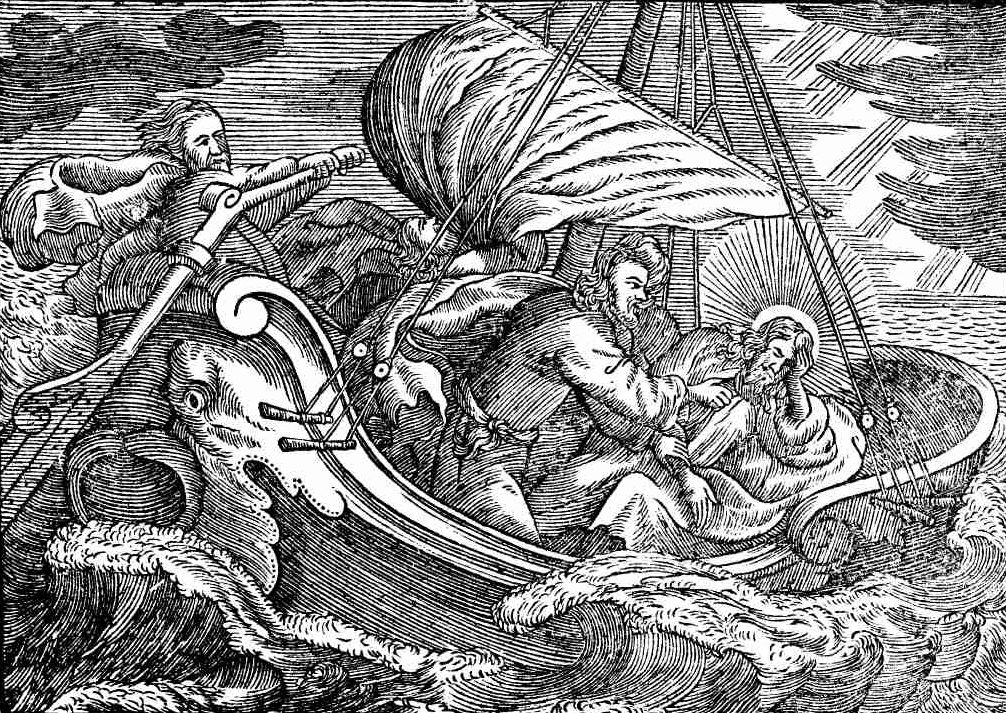
Jesus asleep in the storm
The first part of the passsage is about hearing and doing the message of Jesus. Those who hear and obey will shine as witnesses, they will be honest in their witness, hiding nothing: their faith and lives will be transparent to God and their fellow human beings. At this point in the story Jesus’ natural family show that they have not heard and obeyed his message. Jesus’ redefines his family as those who hear and obey.
The storm that follow is surely, in the author’s intention, an image of the storm of opposition Jesus has created by this teaching, which goes against Jewish custom and the natural instincts of humanity. Indeed Jesus’ sleep can be seen as an image of his death brought about by such opposition. Jesus’ awakening is thus an image of his resurrection which will calm all the storms of opposition and give his disciples an invincible faith. Luke shows Jesus’ teaching and actions in the process of creating the “family of Jesus”, the Christian community which he describes in The Acts of the Apostles.
The central point of my interpretation here is that the great storm of opposition is not simply human wickedness but is provoked by the “violence” of Jesus’ teaching. To reject the natural family as the determining relationship in one’s life is an example of Jesus “not bringng peace, but a sword.” (Luke 12: 51-53). Most preachers are content to leave this aspect of Jesus’ ministry in decent obscurity.
 Emmock's Blog