
This blog provides a meditation on the Episcopal daily readings along with a headline from world news:
Killer Karadzic denies Hague charges
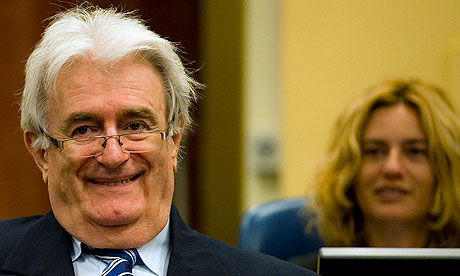
bringer of death
Acts 26:24-27:8
Paul Appeals to Agrippa to Believe
24 While he was making this defence, Festus exclaimed, ‘You are out of your mind, Paul! Too much learning is driving you insane!’25But Paul said, ‘I am not out of my mind, most excellent Festus, but I am speaking the sober truth.26Indeed the king knows about these things, and to him I speak freely; for I am certain that none of these things has escaped his notice, for this was not done in a corner.27King Agrippa, do you believe the prophets? I know that you believe.’28Agrippa said to Paul, ‘Are you so quickly persuading me to become a Christian?’*29Paul replied, ‘Whether quickly or not, I pray to God that not only you but also all who are listening to me today might become such as I am—except for these chains.’
30 Then the king got up, and with him the governor and Bernice and those who had been seated with them;31and as they were leaving, they said to one another, ‘This man is doing nothing to deserve death or imprisonment.’32Agrippa said to Festus, ‘This man could have been set free if he had not appealed to the emperor.’
Paul Sails for Rome
27When it was decided that we were to sail for Italy, they transferred Paul and some other prisoners to a centurion of the Augustan Cohort, named Julius.2Embarking on a ship of Adramyttium that was about to set sail to the ports along the coast of Asia, we put to sea, accompanied by Aristarchus, a Macedonian from Thessalonica.3The next day we put in at Sidon; and Julius treated Paul kindly, and allowed him to go to his friends to be cared for.4Putting out to sea from there, we sailed under the lee of Cyprus, because the winds were against us.5After we had sailed across the sea that is off Cilicia and Pamphylia, we came to Myra in Lycia.6There the centurion found an Alexandrian ship bound for Italy and put us on board.7We sailed slowly for a number of days and arrived with difficulty off Cnidus, and as the wind was against us, we sailed under the lee of Crete off Salmone.8Sailing past it with difficulty, we came to a place called Fair Havens, near the city of Lasea.

Greek ship
My guess is that Luke’s sources supplied him with the information that Paul had fetched up in Rome, as a prisoner of the state;and of course the whole church would have known of his maryrdom there. Luke’s theology told him that such things happened under God’s hand, as part of the continuing ministry of the risen Jesus. The rest of the narrative details are I think, the invention of the author. That doesn’t make them negligible. He wants the reader to see Paul’s innocence of any charge of subversion, so he gives us the views of a Roman official and a monarch. He establishes that Paul was sent to Rome only because he had appealed to the emperor.
I have writen a book about Paul and know at first hand the challenge of linking the known facts about him into a coherent narrative. I also found the record of Paul’s travels astonishing and enjoyed filling out the bare facts with imaginative reconstructions of the journeying itself. That’s what Luke’s doing here. He engages the reader with vivid detail so that he/she can see Paul as a great world traveller for the gospel of Jesus. Luke is above all “ecumenical” in his view of christian faith: the Greek oikumene means the inhabited world: Luke reckons Jesus Christ is good news for all the earth’s inhabitants; and he presents Paul as the main agent of this ecumenical mission.
In a multi-cultural world, there’s a view that any such ecumenical mission would be an insult to people of other faiths. I don’t agree. In some instances Christian missions may have been arrogant, racist and linked to imperialisms. These are serious deformations of what Luke believed, that the story of Jesus, presented and received without prejudice could build peaceful communities anywhere in the world.
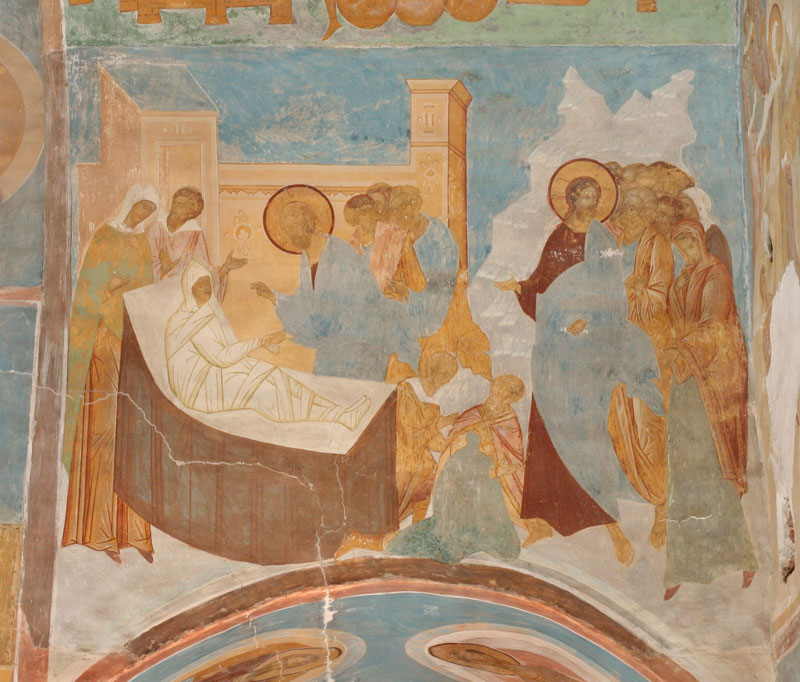
Luke 8:40-56
A Girl Restored to Life and a Woman Healed
40 Now when Jesus returned, the crowd welcomed him, for they were all waiting for him.41Jus6t then there came a man named Jairus, a leader of the synagogue. He fell at Jesus’ feet and begged him to come to his house,42for he had an only daughter, about twelve years old, who was dying.
As he went, the crowds pressed in on him.43Now there was a woman who had been suffering from haemorrhages for twelve years; and though she had spent all she had on physicians,* no one could cure her.44She came up behind him and touched the fringe of his clothes, and immediately her haemorrhage stopped.45Then Jesus asked, ‘Who touched me?’ When all denied it, Peter* said, ‘Master, the crowds surround you and press in on you.’46But Jesus said, ‘Someone touched me; for I noticed that power had gone out from me.’47When the woman saw that she could not remain hidden, she came trembling; and falling down before him, she declared in the presence of all the people why she had touched him, and how she had been immediately healed.48He said to her, ‘Daughter, your faith has made you well; go in peace.’
49 While he was still speaking, someone came from the leader’s house to say, ‘Your daughter is dead; do not trouble the teacher any longer.’50When Jesus heard this, he replied, ‘Do not fear. Only believe, and she will be saved.’51When he came to the house, he did not allow anyone to enter with him, except Peter, John, and James, and the child’s father and mother.52They were all weeping and wailing for her; but he said, ‘Do not weep; for she is not dead but sleeping.’53And they laughed at him, knowing that she was dead.54But he took her by the hand and called out, ‘Child, get up!’55Her spirit returned, and she got up at once. Then he directed them to give her something to eat.56Her parents were astounded; but he ordered them to tell no one what had happened.
life and health
Here is an instance in which Luke stays very close to Mark’s gospel which is one of his sources. Mark invented this way of telling these stories, that is, by nesting the story of the haemoraging woman within the story of the dying girl. Luke adopts this device and uses many other details Mark supplies. Luke is particularly keen on emphasising Jesus ministry to women. These stories involve Jesus settting aside rules of clean/unclean behaviour as they affected contact between men and women in his society. It was considered unclean for a woman to touch a man who was not of her family, as also for a male stranger to touch the body a dead woman. In many societies even today these behaviours woud be condemned.
Luke wants the reader to see that Jesus’ bodily presence, his availability to these women, is itself healing. He does not hold himself apart, but is fully present to them in compassion. He is present in the place of illness to bring healing and in the place of death to bring life. For Luke these are permanent characteristics of Jesus’ ministry in all times and places. The picture of Jesus entering the place of death in order to issue the command to “get up”, is a fundametal image of salvation.
In the course of my ministry I’ve met many people whose lives were dedicated to bring health to the sick and life to the dying. I’d like to note just one of these, Dr. Pamela Levack, consultant physician in Palliative Medicine at Ninewells Hospital and Roxburghe House, Dundee. She has said that medical practice must rid itself of its fear of failure, and learn to treat those who are going to die, as living people, who can benefit from skilled support. She has learned how to do this with great skill, respect and compassion, and can help others to do so. She is a member of the Baptist Church.
 Emmock's Blog