
THIS BLOG PROVIDES A MEDITATION ON THE EPISCOPAL DAILY READINGS ALONG WITH A HEADLINE FROM WORLD NEWS:
UK racist co-opts Christianity to attack gays
(in response to a gay couple winning damages for being refused a double room in a Christian B&B)

Nick Griffin leader of the BNP
Acts 28:1-16
Paul on the Island of Malta
28After we had reached safety, we then learned that the island was called Malta.2The natives showed us unusual kindness. Since it had begun to rain and was cold, they kindled a fire and welcomed all of us round it.3Paul had gathered a bundle of brushwood and was putting it on the fire, when a viper, driven out by the heat, fastened itself on his hand.4When the natives saw the creature hanging from his hand, they said to one another, ‘This man must be a murderer; though he has escaped from the sea, justice has not allowed him to live.’5He, however, shook off the creature into the fire and suffered no harm.6They were expecting him to swell up or drop dead, but after they had waited a long time and saw that nothing unusual had happened to him, they changed their minds and began to say that he was a god.
7 Now in the neighbourhood of that place were lands belonging to the leading man of the island, named Publius, who received us and entertained us hospitably for three days.8It so happened that the father of Publius lay sick in bed with fever and dysentery. Paul visited him and cured him by praying and putting his hands on him.9After this happened, the rest of the people on the island who had diseases also came and were cured.10They bestowed many honours on us, and when we were about to sail, they put on board all the provisions we needed.
Paul Arrives at Rome
11 Three months later we set sail on a ship that had wintered at the island, an Alexandrian ship with the Twin Brothers as its figurehead.12We put in at Syracuse and stayed there for three days;13then we weighed anchor and came to Rhegium. After one day there a south wind sprang up, and on the second day we came to Puteoli.14There we found believers* and were invited to stay with them for seven days. And so we came to Rome.15The believers* from there, when they heard of us, came as far as the Forum of Appius and Three Taverns to meet us. On seeing them, Paul thanked God and took courage.
16 When we came into Rome, Paul was allowed to live by himself, with the soldier who was guarding him.
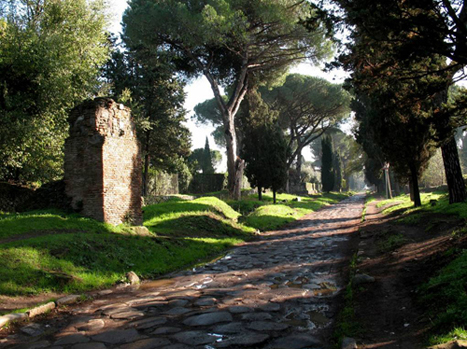
Forum of Appius, Via Appia
“And so we came to Rome.” This is where Luke’s great narrative has been heading ever since he depicted the risen Jesus leaving his disciples to get on with the job in the world. He has charted the means by which an obscure sect of Messianic Jews transformed itself into a world-wide community of Jews and non-Jews, worshipping one God, following the teachings ofJesus and living in the Spirit of sharing. It has been the story of a new exodus whereby the ministry of Jesus has broken out of the shackles of one race and its traditions, to offer its best fruits to all the world. It has therefore involved the conversion of its members to a new openness towards non-Jews and a costly separation from those Jews who refused this change. Above all it is demonstrated the continuing liveliness of Jesus Messiah who through his disciples continues to spread the rule of God’s goodness on earth.
Luke 9:28-36
The Transfiguration
28 Now about eight days after these sayings Jesus* took with him Peter and John and James, and went up on the mountain to pray.29And while he was praying, the appearance of his face changed, and his clothes became dazzling white.30Suddenly they saw two men, Moses and Elijah, talking to him.31They appeared in glory and were speaking of his departure, which he was about to accomplish at Jerusalem.32Now Peter and his companions were weighed down with sleep; but since they had stayed awake,* they saw his glory and the two men who stood with him.33Just as they were leaving him, Peter said to Jesus, ‘Master, it is good for us to be here; let us make three dwellings,* one for you, one for Moses, and one for Elijah’—not knowing what he said.34While he was saying this, a cloud came and overshadowed them; and they were terrified as they entered the cloud.35Then from the cloud came a voice that said, ‘This is my Son, my Chosen;* listen to him!’36When the voice had spoken, Jesus was found alone. And they kept silent and in those days told no one any of the things they had seen.
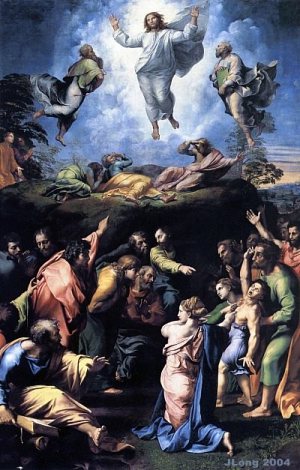
Exodus: the light from the transgfigured Jesus issues on to the face of the epileptic boy below
I am struck by the coincidence of this passage appearing in today’s lectionary reading when I referred to it in the context of my blog 859 on Acts, yesterday. Here in a mountain scene, Luke cunningly gives us an insight into the whole ministry of Jesus. Firstly he reminds the reader by the use of a mountain of the tradition of mountain stories in Judaism, especially of Sinai (the mountain of Torah) and Carmel (the mountain of prophecy, where God confirmed the truth of Elijah’s faith). It’s not surprising that Moses and Elijah, representing the core of Jewish faith, the Torah and the prophetic Word, should be with Jesus. The sleepiness of the disciples here will chime later in the gospel with their sleepiness in the garden of Gethsemane, before the crucifixion. The subject of conversation is Jesus’ departure, in Greek, his exodus, which he will accomplish by his death and resurrection. Luke means his readers to understand the apparent failure of Jesus’ ministry as the beginning of a new exodus, in which God will lead his people into a new and greater freedom. Peter suggests that this moment should be preserved and honoured on this spot. That’s precisely the wrong response to the call of a new exodus and merits the rebuke, “This is my beloved son: lisen to him!”Sometimes the impusle of Christian ministry has been to build dwellings for worship rather than following Jesus out into the needy and dangerous world. It’s not that buildings are bad or unnecessary but whether they are used a static monuments or staging posts. The same is true metaphorically of personal faith. Nothing is more modern than an emphasis on building our personal spirituality. Somewhere in that, there may be something genuine (Jesus asked his disciples to “watch and pray”) but all too often it results in pious people disappearing up their own asses. True spirituality begins with obedience to the command “This is my beloved son: listen to Him!” and readiness for the resultant journey.
 Emmock's Blog