
This blog provides a meditation on the episcopal daily readings along with a hadline from world news.
Home Secretary Spends £10,000 public money on stuffed snake

William Hague repairs stuffed anaconda
Revelation 13:1-10
131And I saw a beast rising out of the sea, having ten horns and seven heads; and on its horns were ten diadems, and on its heads were blasphemous names.2And the beast that I saw was like a leopard, its feet were like a bear’s, and its mouth was like a lion’s mouth. And the dragon gave it his power and his throne and great authority.3One of its heads seemed to have received a death-blow, but its mortal wound* had been healed. In amazement the whole earth followed the beast.4They worshipped the dragon, for he had given his authority to the beast, and they worshipped the beast, saying, ‘Who is like the beast, and who can fight against it?’
5 The beast was given a mouth uttering haughty and blasphemous words, and it was allowed to exercise authority for forty-two months.6It opened its mouth to utter blasphemies against God, blaspheming his name and his dwelling, that is, those who dwell in heaven.7Also, it was allowed to make war on the saints and to conquer them.* It was given authority over every tribe and people and language and nation,8and all the inhabitants of the earth will worship it, everyone whose name has not been written from the foundation of the world in the book of life of the Lamb that was slaughtered.*
9 Let anyone who has an ear listen:
10 If you are to be taken captive, into captivity you go;
if you kill with the sword, with the sword you must be killed.
Here is a call for the endurance and faith of the saints.
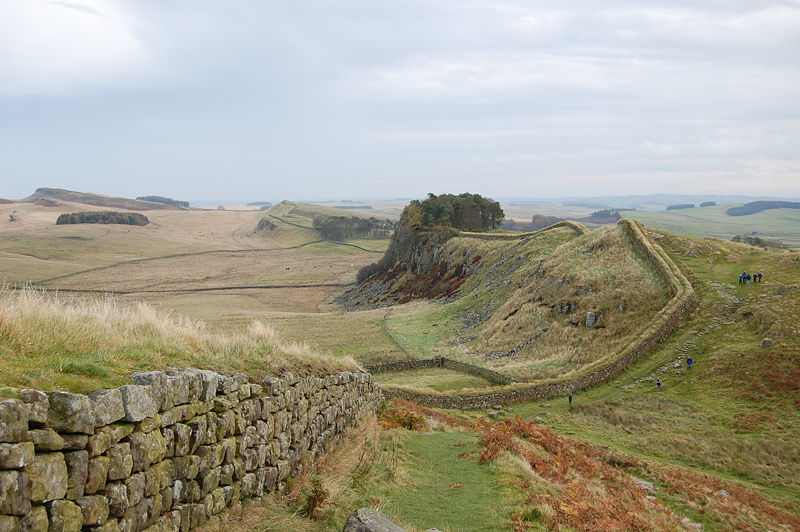
What the Romans did: Hadrian’s Wall kept the English out of Scotland
Here the author depicts the precise relationship between Rome and the Dragon. The Roman Empire, characterised by its seven heads, rises out of the sea (a symbol of chaos) and dominates the world in the power of the dragon, that is, of evil. In its survival of a life-threatening injury it mimics the resurrection of Jesus and in its arrogance it mimics the power of God. Historians of civilization (not to mention comedians, “What did the Romans ever do for us?”) find this characterisation of a great civilisation ridiculous and dismiss it as a religious aberration. Doubtless the messianic communities connected with this prophecy used Roman roads, benefitted from Roman administration, drank from Roman water supplies, as much as any inhabitants of the empire. Yet they saw it with the sharp eyes of Jewish prophecy, aware of gross injustice to human beings and blasphemous pride towards the one God, and therefore judged that it would fall before the courage and sacrifice of people committed to the Lamb, who would endure the cruelties brought upon them by the Empire. These were not jihadists, but stubborn, quiet, law-abiding people, who insisted on practicing their religion and refused to perform any action that recognised Rome or Caesar as divine. For those small refusals and for patiently building their own communities of mutual care, the Roman state persecuted them for more than two hundred years. The fact that they, when they at last gained power, persecuted pagans and heretics, is evidence that the power of the beast is greater thaneven the author of The Revelation imagined.
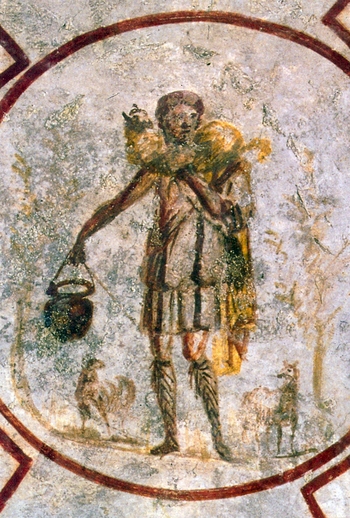
Image of Good Shepherd from Christian catacomb in Rome
There are many places in the world where poor people say, “Who is like the beast and who can fight against it?” Many eastern Europeans felt this about the Soviet Union, many South Americans felt this about the USA, doubtless many Tibetans feel this about China. Great regional powers can do,and have done, multiple evils to maintain their pre-eminence, taking care to conceal their violence as much as possible from conscientious people amongst their own citizenry. The tradition of Jewish prophecy continued and renewed in the book of The Revelation is in permanent opposition to that sort of domination and its supporters.
 Emmock's Blog