This blog provides a meditation on the Episcopal daily readings along with a headline from world news:
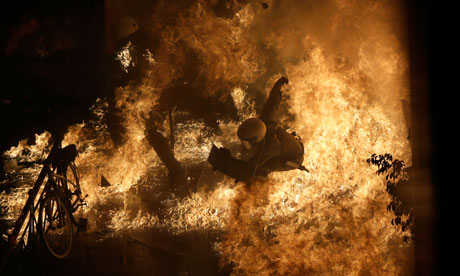
Austerity causes anger in 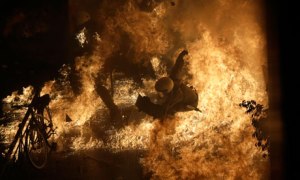 Athens
Revelation 16:12-21
12 The sixth angel poured his bowl on the great river Euphrates, and its water was dried up in order to prepare the way for the kings from the east.13And I saw three foul spirits like frogs coming from the mouth of the dragon, from the mouth of the beast, and from the mouth of the false prophet.14These are demonic spirits, performing signs, who go abroad to the kings of the whole world, to assemble them for battle on the great day of God the Almighty.15(‘See, I am coming like a thief! Blessed is the one who stays awake and is clothed,* not going about naked and exposed to shame.’)16And they assembled them at the place that in Hebrew is called Harmagedon.
17 The seventh angel poured his bowl into the air, and a loud voice came out of the temple, from the throne, saying, ‘It is done!’18And there came flashes of lightning, rumblings, peals of thunder, and a violent earthquake, such as had not occurred since people were upon the earth, so violent was that earthquake.19The great city was split into three parts, and the cities of the nations fell. God remembered great Babylon and gave her the wine-cup of the fury of his wrath.20And every island fled away, and no mountains were to be found;21and huge hailstones, each weighing about a hundred pounds,* dropped from heaven on people, until they cursed God for the plague of the hail, so fearful was that plague.
As I’ve written in previous blogs, the clue to the visions of Revelation is to remember that God’s victories are won through the faithfulness of the Lamb and those who follow the Lamb. It is their faithfulness even to death which “fuels” the the natural disasters and angelic armies that express God’s justice. Evil is presented as powerful but inherently self-destructive, contributing to its own defeat.
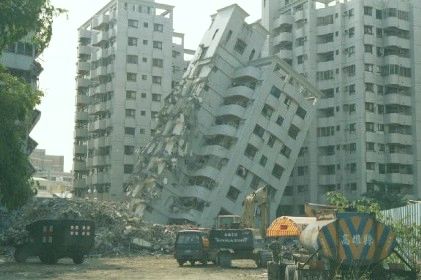 Probably the details of the two final bowls of wrath point to the Roman Empire. When the River Euphrates dries up the Empire will have no barrier against the invading Parthians. The violent human beings are to receive their judgement at “Har-Mageddon” literally, the Mountains of Megiddo” in Northern Israel, known for the defeat in battle there of King Josiah. The Great City of Babylon, which means the Roman Empire in its demonic aspect, will be shattered and deprived of power, while creation itself will be subjected to an influx of chaos.
In the middle of this,there is a message from Jesus to his suffering disciples, ” I am coming like a thief” – words elsewhere recorded as a warning that the coming of the Messiah will not be obvious. In this case the faithful are urged not to lose faith because of the destructive chaos brought upon themselves by evil powers, but rather to “keep their garments”, that is, the robes of suffering which have been “cleansed in the blood of the Lamb”, signifying their true discipleship, and not to go naked, that is to free themselves from the risks of belonging to Jesus, who will return.
The language of the Revelation is violent, strange, repetitive and obscure to the modern reader; but its message to persecuted believers is simple: in their faithfulness to the Lamb, God wins his victory over evil. For them, there are tears, but God will wipe them away. The powers of evil are as nothing in the presence of God’s saving justice.
Luke 13:18-30
The Parable of the Mustard Seed
18 He said therefore, ‘What is the kingdom of God like? And to what should I compare it?19It is like a mustard seed that someone took and sowed in the garden; it grew and became a tree, and the birds of the air made nests in its branches.’<!– 20 –>
The Parable of the Yeast
20 And again he said, ‘To what should I compare the kingdom of God?21It is like yeast that a woman took and mixed in with* three measures of flour until all of it was leavened.’
The Narrow Door
22 Jesus* went through one town and village after another, teaching as he made his way to Jerusalem.23Someone asked him, ‘Lord, will only a few be saved?’ He said to them,24‘Strive to enter through the narrow door; for many, I tell you, will try to enter and will not be able.25When once the owner of the house has got up and shut the door, and you begin to stand outside and to knock at the door, saying, “Lord, open to us”, then in reply he will say to you, “I do not know where you come from.”26Then you will begin to say, “We ate and drank with you, and you taught in our streets.”27But he will say, “I do not know where you come from; go away from me, all you evildoers!”28There will be weeping and gnashing of teeth when you see Abraham and Isaac and Jacob and all the prophets in the kingdom of God, and you yourselves thrown out.29Then people will come from east and west, from north and south, and will eat in the kingdom of God.30Indeed, some are last who will be first, and some are first who will be last.’
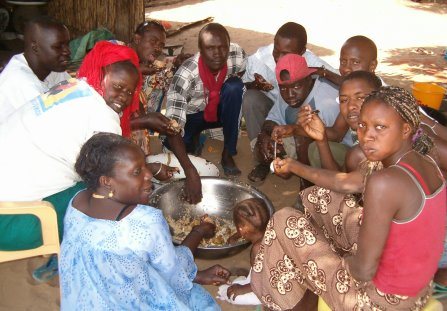
to live in the generosity of God
What’s the relationship between the kingdom as a broad tree that shelters many and the kingdom as having a narrow door? Answer: The broad tree starts as a tiny seed. The kingdom or rule of God starts small, with poor people in little unimportant villages deciding to embrace the stringency and joy of God’s will revealed by Jesus. They learn with difficulty how to live in the generosity of God. Ultimately their communities will grow and offer “shelter” to all nationalities. But entering will always involve becoming small like the seed, or shedding worldly encumbrances, both material and spiritual, to enter by the narrow door. Jesus was speaking about the community of disciples on earth and “in heaven.”
Having a hail-fellow-well-met relationship with Jesus (“we ate and drank with you”-watch out, Christian, that might easily apply to Holy Communion!), is not enough. Now is the time to come in by that narrow door, to throw away everything that makes me too big to get through it.
 Emmock's Blog