
This blog provides a meditation on the Episcopal daily readings along with a headline from world news:
“Obama means World War 3,” deranged British Journalist says

Melanie Philips
Revelation 17:1-18
The Great Whore and the Beast
17Then one of the seven angels who had the seven bowls came and said to me, ‘Come, I will show you the judgement of the great whore who is seated on many waters,2with whom the kings of the earth have committed fornication, and with the wine of whose fornication the inhabitants of the earth have become drunk.’3So he carried me away in the spirit* into a wilderness, and I saw a woman sitting on a scarlet beast that was full of blasphemous names, and it had seven heads and ten horns.4The woman was clothed in purple and scarlet, and adorned with gold and jewels and pearls, holding in her hand a golden cup full of abominations and the impurities of her fornication;5and on her forehead was written a name, a mystery: ‘Babylon the great, mother of whores and of earth’s abominations.’6And I saw that the woman was drunk with the blood of the saints and the blood of the witnesses to Jesus.
When I saw her, I was greatly amazed.7But the angel said to me, ‘Why are you so amazed? I will tell you the mystery of the woman, and of the beast with seven heads and ten horns that carries her.8The beast that you saw was, and is not, and is about to ascend from the bottomless pit and go to destruction. And the inhabitants of the earth, whose names have not been written in the book of life from the foundation of the world, will be amazed when they see the beast, because it was and is not and is to come.
9 ‘This calls for a mind that has wisdom: the seven heads are seven mountains on which the woman is seated; also, they are seven kings,10of whom five have fallen, one is living, and the other has not yet come; and when he comes, he must remain for only a little while.11As for the beast that was and is not, it is an eighth but it belongs to the seven, and it goes to destruction.12And the ten horns that you saw are ten kings who have not yet received a kingdom, but they are to receive authority as kings for one hour, together with the beast.13These are united in yielding their power and authority to the beast;14they will make war on the Lamb, and the Lamb will conquer them, for he is Lord of lords and King of kings, and those with him are called and chosen and faithful.’
15 And he said to me, ‘The waters that you saw, where the whore is seated, are peoples and multitudes and nations and languages.16And the ten horns that you saw, they and the beast will hate the whore; they will make her desolate and naked; they will devour her flesh and burn her up with fire.17For God has put it into their hearts to carry out his purpose by agreeing to give their kingdom to the beast, until the words of God will be fulfilled.18The woman you saw is the great city that rules over the kings of the earth.’
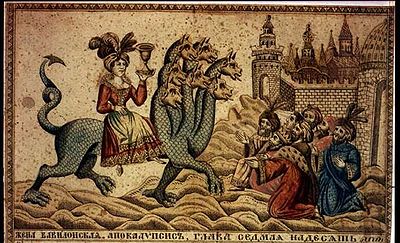
Whore and Beast
Here the identity of the “Great Whore” is made plain: she is Rome, seated on its seven hills with its history of seven emperors. The female image indicates that not only the historical city but also its Goddess Roma (statues of whom can still be seen in former cities of the Empire), is the target of the prophet’s invective. Hebrew prophets used prostitution as a metaphor for idolatry, a) because religious license is compared to sexual license and b) because many of the Canaanite religions used sacred prostitution as part of their rituals. The Revelation always depicts Rome as the author of oppression, violence and arrogant idolatry of its own power.
The beast becomes more mysterious in this passage. It is linked to Rome, yet not identified with her. It is a parody of God, -“was, is not, and is to come back,” – but it is obviously not divine. Scholars point to the contemporary legends of Nero, who was emperor, has died (is not) but was expected to come back, at the head of an army from the East to destroy Rome. The author of the Revelation makes this monster an image of the demonic destructiveness which underlies the imperial rule of Rome.

lamb
Critics of this author will say that he hadn’t thought very hard about what it might be like suffer the tender mercies of the Parthians, Goths, Vandals and so on, nor given credit to Rome for the its civilising order. That’s true of course, but he and his fellow believers were undergoing specific persecution. What he can see is the brutality and arrogance of Empire. Doubtless he would have found just as sharp criticism for the savagery of Rome’s destroyers. His strong language comes from being representative of a peaceful people prepared to suffer for its beliefs but able to see through the imperial propaganda which told them their persecution was necessary for peace. Again and again the author returns to his central conviction: in the battle of bestial forces, the sacrificed Lamb will conquer.
 Emmock's Blog