This blog provides a meditation on the Episcopal daily readings along with a headline from world news:
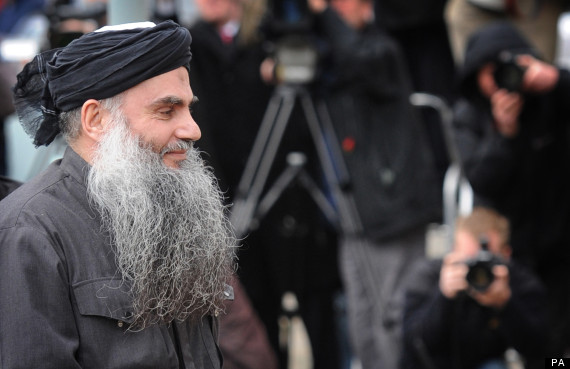
Preacher of violence saved from violence by UK law
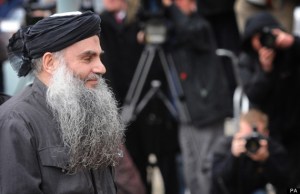
- Abu Qatada
Revelation 19:11-21
The Rider on the White Horse
11 Then I saw heaven opened, and there was a white horse! Its rider is called Faithful and True, and in righteousness he judges and makes war.12His eyes are like a flame of fire, and on his head are many diadems; and he has a name inscribed that no one knows but himself.13He is clothed in a robe dipped in* blood, and his name is called The Word of God.14And the armies of heaven, wearing fine linen, white and pure, were following him on white horses.15From his mouth comes a sharp sword with which to strike down the nations, and he will rule* them with a rod of iron; he will tread the wine press of the fury of the wrath of God the Almighty.16On his robe and on his thigh he has a name inscribed, ‘King of kings and Lord of lords’.<!– 17 –>
The Beast and Its Armies Defeated
17 Then I saw an angel standing in the sun, and with a loud voice he called to all the birds that fly in mid-heaven, ‘Come, gather for the great supper of God,18to eat the flesh of kings, the flesh of captains, the flesh of the mighty, the flesh of horses and their riders—flesh of all, both free and slave, both small and great.’19Then I saw the beast and the kings of the earth with their armies gathered to make war against the rider on the horse and against his army.20And the beast was captured, and with it the false prophet who had performed in its presence the signs by which he deceived those who had received the mark of the beast and those who worshipped its image. These two were thrown alive into the lake of fire that burns with sulphur.21And the rest were killed by the sword of the rider on the horse, the sword that came from his mouth; and all the birds were gorged with their flesh.
 This is a splendid and subtle vision. The rider is Jesus Christ who conquers evil effortlessly it would appear, but the descriptive details show the means of this victory. His robe dipped in blood is the sign of his suffering, the secret name is the name of God which cannot be spoken, he treads the wine-press of God’s anger in the turmoil of his death and by the power of his word (the sword of the mouth) he destroys the power of evil. The author is telling us again that Christ wins his victory in and through his cross which demonstrates an invincible love. Invincible? When so many evil people are consigned to death? Yes, the love of God is precisely that he will persuade people towards their own good but will not force them. This in turn means that there will be evil if people choose it. God in his Messiah–Son enters this evil and wrestles with it (this is the winepress) so that those who do not choose it may be rescued. But those who insist on choosing it are swallowed up in the evil which God has permitted and must die. This is, and only this is the wrath of God.
We can note that the reward of evil is a parody of holy communion in which the faithful “eat” the flesh and drink the blood of Christ. Here the flesh of evildoers becomes a banquet for the birds of the air. This a reminder that both damnation and salvation, good and evil, death and life, are intimately connected with the “flesh” of human beings, which God has created and cannot simply be by-passed. As opposed to all spiritualities which denigrate material and bodily life, according to the Christian gospel, human life is an embodied life which God wants to restore to its original splendour. Evil on the other hand destroys the body as well as the spirit.
Luke 15:1-10
The Parable of the Lost Sheep
15Now all the tax-collectors and sinners were coming near to listen to him.2And the Pharisees and the scribes were grumbling and saying, ‘This fellow welcomes sinners and eats with them.’
3 So he told them this parable:4‘Which one of you, having a hundred sheep and losing one of them, does not leave the ninety-nine in the wilderness and go after the one that is lost until he finds it?5When he has found it, he lays it on his shoulders and rejoices.6And when he comes home, he calls together his friends and neighbours, saying to them, “Rejoice with me, for I have found my sheep that was lost.”7Just so, I tell you, there will be more joy in heaven over one sinner who repents than over ninety-nine righteous people who need no repentance.<!– 8 –>
The Parable of the Lost Coin
8 ‘Or what woman having ten silver coins,* if she loses one of them, does not light a lamp, sweep the house, and search carefully until she finds it?9When she has found it, she calls together her friends and neighbours, saying, “Rejoice with me, for I have found the coin that I had lost.”10Just so, I tell you, there is joy in the presence ofthe angels of God over one sinner who repents.’

not every lost sheep is cuddly
Jesus’s extraordinary stories of God’s forgiveness rest on the same assumption as above: God in his love persuades sinners to turn to him but never compels. The decision to turn one’s life around is a response to God’s goodness but it is a free decision of the human person. That’s one reason why it gives such pleasure to God-the sinners desires his company. The other reason is that God in the foolishness and indignity of his love goes the distance with the sinner, into the place of loss, and finds him; or gets on his knees and searches his house to find him. The implications of these stories are not simply a declaration of God’s joyful welcome to sinners who come back, but also a challenge to those “righteous” people who will not share this divine joy. Indeed they don’t share it because they have not accompanied God on his mission of finding the lost. There’s something mean about Jesus’ critics: it’s not the rescue of repentant sinners that gets up their nose, it’s the joy of the rescuer. Their distance from joy is their distance from God.
 Emmock's Blog