
This blog provides a meditation on the Episcopal daily readings along with a headline from world news:
Climate change will hit poor nations more severely says World Bank

flood in Bangkok
James 2:14-26
Faith without Works Is Dead
14 What good is it, my brothers and sisters,* if you say you have faith but do not have works? Can faith save you?15If a brother or sister is naked and lacks daily food,16and one of you says to them, ‘Go in peace; keep warm and eat your fill’, and yet you do not supply their bodily needs, what is the good of that?17So faith by itself, if it has no works, is dead.
18 But someone will say, ‘You have faith and I have works.’ Show me your faith without works, and I by my works will show you my faith.19You believe that God is one; you do well. Even the demons believe—and shudder.20Do you want to be shown, you senseless person, that faith without works is barren?21Was not our ancestor Abraham justified by works when he offered his son Isaac on the altar?22You see that faith was active along with his works, and faith was brought to completion by the works.23Thus the scripture was fulfilled that says, ‘Abraham believed God, and it was reckoned to him as righteousness’, and he was called the friend of God.24You see that a person is justified by works and not by faith alone.25Likewise, was not Rahab the prostitute also justified by works when she welcomed the messengers and sent them out by another road?26For just as the body without the spirit is dead, so faith without works is also dead.

- “Keep warm and make sure you eat”
This is a famous passage. It looks as if it is a rebuttal of a one-sided version of Paul’s teaching that believers are “justified by faith apart from the works of the law” (Galatians 2:15-16). I say “one-sided” because Paul is not attacking good deeds but rather the whole system of the Jewish Torah as a means of salvation. He teaches that people do not need to, indeed they cannot, earn God’s acceptance by Torah obedience; rather they should receive the good news that God in Jesus Messiah has already accepted them, so that they may become fruitful in good deeds. Somewhere along the line this complex theology must have been simplified into the view that “all you need is faith, forget good deeds.” It is this dangerously one-sided teaching that James attacks so forcefully. In doing so perhaps he becomes a little one-sided himself. He might well have agreed that works without faith are also dead. In a sense both Paul and James are trying to express a unity of faith and action evident in Jesus’ ministry. For him, acceptance and the call to discipleship are one message; trusting God’s love and doing God’s will are two sides of the one coin.
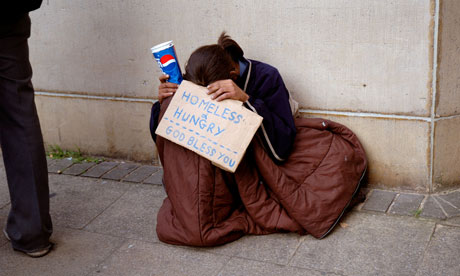
We can certainly enjoy James’s splendid and sarcastic characterisation of the comfy Christian who wishes the homeless person well but does nothing to help. Indeed we can ask if it doesn’t get a bit closer to us than we like. His common sense wisdom derives from his Jewish-Christian tradition which holds on to aspects of the teaching and example of Jesus which are notably absent from St. Paul’s letters. Along with the first three gospels his writing supplies a permanent corrective to forms of Christianity in which right faith is exalted at the expense of right action.
Government welfare “reform” in the UK will mean that many poorer people have less money and will be unable to afford their accommodation in more expensive areas, like London. Families will be uprooted and many will become homeless trying to relocate to less expensive parts of the country. It’s right that the churches in the UK should condemn these measures but more important that they should make resources available to such families. Otherwise they’ll be in the position of James’s comfortable Christians who say to the destitute, “Keep warm and eat.”
Luke 16:19-31
The Rich Man and Lazarus
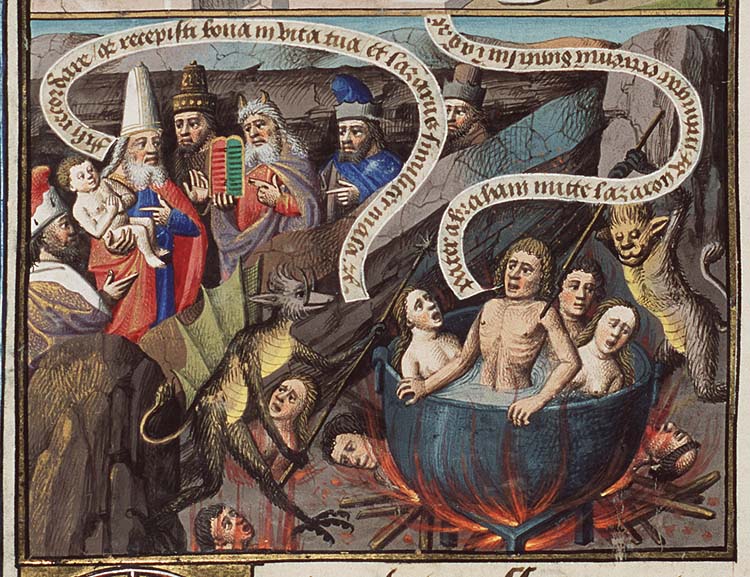
19 ‘There was a rich man who was dressed in purple and fine linen and who feasted sumptuously every day.20And at his gate lay a poor man named Lazarus, covered with sores,21who longed to satisfy his hunger with what fell from the rich man’s table; even the dogs would come and lick his sores.22The poor man died and was carried away by the angels to be with Abraham.* The rich man also died and was buried.23In Hades, where he was being tormented, he looked up and saw Abraham far away with Lazarus by his side.*24He called out, “Father Abraham, have mercy on me, and send Lazarus to dip the tip of his finger in water and cool my tongue; for I am in agony in these flames.”25But Abraham said, “Child, remember that during your lifetime you received your good things, and Lazarus in like manner evil things; but now he is comforted here, and you are in agony.26Besides all this, between you and us a great chasm has been fixed, so that those who might want to pass from here to you cannot do so, and no one can cross from there to us.”27He said, “Then, father, I beg you to send him to my father’s house—28for I have five brothers—that he may warn them, so that they will not also come into this place of torment.”29Abraham replied, “They have Moses and the prophets; they should listen to them.”30He said, “No, father Abraham; but if someone goes to them from the dead, they will repent.”31He said to him, “If they do not listen to Moses and the prophets, neither will they be convinced even if someone rises from the dead.” ’
 Emmock's Blog