
This blog is one person’s daily discipline of bible reading. It uses the Episcopal Church’s list of readings for every day in the year (Lectionary) and gives a personal meditation on it, while remembering what’s going on the world with a headline reference to the news. Readers can access past blogs from the date list onscreen right or by googling emmock.com plus scripture reference or theme.
Union Flag dispute arouses sectarian threats in Belfast 
1 Thessalonians 4:1-12
A Life Pleasing to God
4 Finally, brothers and sisters,* we ask and urge you in the Lord Jesus that, as you learned from us how you ought to live and to please God (as, in fact, you are doing), you should do so more and more.2For you know what instructions we gave you through the Lord Jesus.3For this is the will of God, your sanctification: that you abstain from fornication;4that each one of you knows how to control your own body* in holiness and honour,5not with lustful passion, like the Gentiles who do not know God;6that no one wrongs or exploits a brother or sister* in this matter, because the Lord is an avenger in all these things, just as we have already told you beforehand and solemnly warned you.7For God did not call us to impurity but in holiness.8Therefore whoever rejects this rejects not human authority but God, who also gives his Holy Spirit to you.
9 Now concerning love of the brothers and sisters,* you do not need to have anyone write to you, for you yourselves have been taught by God to love one another;10and indeed you do love all the brothers and sisters* throughout Macedonia. But we urge you, beloved,* to do so more and more,11to aspire to live quietly, to mind your own affairs, and to work with your hands, as we directed you,12so that you may behave properly towards outsiders and be dependent on no one.
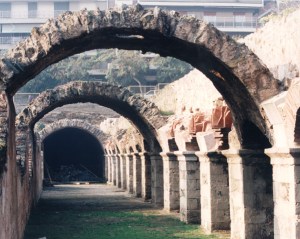
The forum in Thessaloniki
Paul’s affection for his Thessalonian converts is clear in this letter. He acknowledges their sincere effort to live as followers of Jesus Messiah. He insists however that God wants them to become holy in ordinary living. This insistence may come from his training as a Pharisee who were especially concerned with holy living by lay people as well as priests. The easy-going sexual morality of the Greek culture is to be replaced by the more austere Jewish tradition which emphasised self-control and saw promiscuity as destructive of community life. This last reason is especially applicable to a small Christian community in a large Greek city. There was a large Jewish population in Thessaloniki, the majority of whom refused the message of Jesus Messiah brought by Paul and Titus. Any loose behaviour by Christian converts would have disgraced the new faith in the eyes of the Jewish community.
Paul understood how easily the believers could be seen as a new-fangled cult. He therefore urged them to a warm love for each other and their fellow believers in other places, as well as a quiet down-to-earth style of living which would commend their beliefs to others. For Paul who rejected the authority of Torah, the freedom of a Christian person was real but limited by what was good for the person’s own growth in holiness; for the life of the Christian community; and for the reputation of that community amongst non-believers.
Luke 20:45-21:4
45 In the hearing of all the people he said to the* disciples,46‘Beware of the scribes, who like to walk around in long robes, and love to be greeted with respect in the market-places, and to have the best seats in the synagogues and places of honour at banquets.47They devour widows’ houses and for the sake of appearance say long prayers. They will receive the greater condemnation.’
The Widow’s Offering
He looked up and saw rich people putting their gifts into the treasury;2he also saw a poor widow put in two small copper coins.3He said, ‘Truly I tell you, this poor widow has put in more than all of them;4for all of them have contributed out of their abundance, but she out of her poverty has put in all she had to live on.’
Luke places the story of the widow’s offering immediately after Jesus’ pungent criticism of the scribes whose social eminence is gained at the expense of the poor. Doubtless there were sincere scribes who did not behave in this way but Jesus view of them as a class of religious officials chimes with the persistent denunciations of the same class by Israel’s prophetic tradition.
True faith is not this strutting display of piety but the devotion of the heart shown by the widow who gives her “livelihood”, that is, who deprives herself of perhaps her day’s meal in order to make an offering. Honest and unostentatious devotion which expresses a sincere love of God is commended by Jesus. When this Christmas I give to my favourite charities without seriously denting my bank balance, what sort of verdict does Jesus pass on me?
We should notice that the decent, serious life-style praised by Jesus is similar to that urged on his Thessalonians by Paul.
 Emmock's Blog