
“A strange mixture of pious study and blasphemous rant, based on the Episcopal daily scripture. Read with care!” The Theologian Online 2012
The daily headline: Pope’s First Tweet

I bless all of you….
Isaiah 7:1-9
Isaiah Reassures King Ahaz
7In the days of Ahaz son of Jotham son of Uzziah, king of Judah, King Rezin of Aram and King Pekah son of Remaliah of Israel went up to attack Jerusalem, but could not mount an attack against it.2When the house of David heard that Aram had allied itself with Ephraim, the heart of Ahaz* and the heart of his people shook as the trees of the forest shake before the wind.
3 Then the Lord said to Isaiah, Go out to meet Ahaz, you and your son Shear-jashub,* at the end of the conduit of the upper pool on the highway to the Fuller’s Field,4and say to him, Take heed, be quiet, do not fear, and do not let your heart be faint because of these two smouldering stumps of firebrands, because of the fierce anger of Rezin and Aram and the son of Remaliah.5Because Aram—with Ephraim and the son of Remaliah—has plotted evil against you, saying,6Let us go up against Judah and cut off Jerusalem* and conquer it for ourselves and make the son of Tabeel king in it;7therefore thus says the Lord God:
It shall not stand, and it shall not come to pass.
8 For the head of Aram is Damascus, and the head of Damascus is Rezin.
(Within sixty-five years Ephraim will be shattered, no longer a people.)
9 The head of Ephraim is Samaria, and the head of Samaria is the son of Remaliah.
If you do not stand firm in faith, you shall not stand at all.

a clear head, Ban Ki-moon of the UN
A complex international episode lies behind this prophecy. The rulers of Damascus and Ephraim (Israel) wanted to force Judah to support their war against Assyria, and invaded Judah to overcome its reluctance. Ahaz was panicking but Isaiah counselled that the person who trusted in the God beyond politics, would be able to face political problems with a clear head. The last line above is an almost untranslatable pun between the Hebrew words for “faith” and “standing firm”. The great Scottish bible scholar, James Moffat, noted that he could have translated it more easily into Scots: no faith, no staith (staying power). It’s a good phrase and might well be adopted as a motto by us all in the face of the trials of life. It does not mean that God will intervene to solve the problem, but rather that our trust in him will enable us to seek solutions with calmness and courage: no faith, no staith. I could certainly benefit from some “staith” in the my own trials this Christmas – a need I share with the millions of people for whom the Christmas bells have a hollow ring.
Luke 22:1-13
The Plot to Kill Jesus
22Now the festival of Unleavened Bread, which is called the Passover, was near.2The chief priests and the scribes were looking for a way to put Jesus* to death, for they were afraid of the people.
3 Then Satan entered into Judas called Iscariot, who was one of the twelve;4he went away and conferred with the chief priests and officers of the temple police about how he might betray him to them.5They were greatly pleased and agreed to give him money.6So he consented and began to look for an opportunity to betray him to them when no crowd was present.
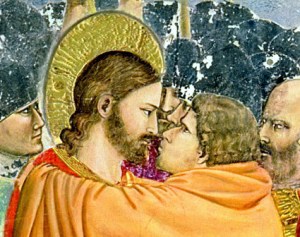
Giotto: Judas kissing Jesus
The relationship between the death of Jesus and the Passover, to which all the gospels bear witness, is complex:
1. The tradition records that the first connection is simply coincidence: Jesus’ arrest and death took place around the time of the Passover feast. The gospels deal with this in characteristically different ways and even disagree on the precise date of the passover meal.
2. Perhaps the oldest interpretation of the coincidence is that of “exodus”: like Moses, Jesus leads his people out of slavery; the way of the cross is the way to freedom.
3. Jesus can be seen as the passover lamb whose blood will prevent God’s wrath coming upon those who trust in him.
4. Jesus’ passover meal with his disciples provides the basis for the Christian sacrament of the Lord’s Supper
In this light Luke’s note that the religious authorities wanted to put Jesus to death has an ironical meaning: by their murderous desire they will make Jesus the key figure in a new exodus of God’s people which will leave them behind.
Judas’ second name we are told may derive ultimately from the Latin for “dagger man” or it may mean no more than that he came from Kerioth, or perhaps its significance has been lost forever. The evidence about Judas in the gospels is minimal, which has made him an ideal figure for scholarly and dramatic interpretation. What can’t really be disputed is that his place in the story is as a representative of the Twelve. He is one of the twelve and he betrayed Jesus. So we can say he stands for the disciples, all of whom betrayed their Lord, even if they didn’t “hand him over” as Judas did. Judas is me, a disciple with the capacity to betray Jesus, not out of weakness, but out of malevolence. Why has he bothered me? How dare he make me feel so small! So how come He’s right all the time? And maybe also…if he’s really the son of God, he’ll overcome my opposition anyway. There’s also a kind of stubborn pleasure in showing that there are limits to Jesus’ power, particularly that he can’t make me love him. To draw near enough Jesus to be a disciple is also to be near enough to betray him.
 Emmock's Blog