This blog tests whether the Christian Bible can provide wisdom for living. It uses the daily readings of the Episcopal Church along with a headline from world news.
Daily Headline: 6 Female teachers / paramedics plus one man killed in Pakistan

funeral of murdered woman aid worker
Genesis 12:1-7
The Call of Abram
12 Now the Lord said to Abram, ‘Go from your country and your kindred and your father’s house to the land that I will show you.2I will make of you a great nation, and I will bless you, and make your name great, so that you will be a blessing.3I will bless those who bless you, and the one who curses you I will curse; and in you all the families of the earth shall be blessed.’*
4 So Abram went, as the Lord had told him; and Lot went with him. Abram was seventy-five years old when he departed from Haran.5Abram took his wife Sarai and his brother’s son Lot, and all the possessions that they had gathered, and the persons whom they had acquired in Haran; and they set forth to go to the land of Canaan. When they had come to the land of Canaan,6Abram passed through the land to the place at Shechem, to the oak* of Moreh. At that time the Canaanites were in the land.7Then the Lord appeared to Abram, and said, ‘To your offspring* I will give this land.’ So he built there an altar to the Lord, who had appeared to him.
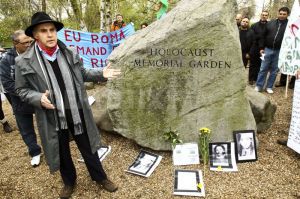
Roma travellers at the Holocaust Memorial
Those who wrote and edited the Jewish bible were inhabitants of a settled civilization in Israel/Palestine, whose wealth came from agriculture and trade. But their traditions express the conviction that their origins as a people were travellers who were “looking for a homeland”, that is, nomadic tribes who roamed the vast area between the fertile crescent and Egypt. This nomadic existence is explained in the tradition by the divine command to “go from your country to a land that I will show you” the land of Canaan; but as the book of Hebrews points out, Abram’s people remained nomads in the land of the promise.
In a sense, Israel’s claim to the land rests on the very dubious grounds of nomadic occupation and ownership of a burial cave.
At a time when travellers, especially Roma, are persecuted throughout Europe by settled populations, who view them with fear and loathing, it’s good to be challenged by this evidence that Christian faith has grown out of the experience of travelling people. The God of such people is a travelling God, whose sphere of influence is not limited to a particular country or sacred space, but who accompanies his people on their wanderings and shares their experiences. Although God may guide them to temporary dwelling or even into what seems to be permanent settlement, he remains himself a truer home for his people than any geographical location can be.
Abram is doubtless not a historical person. His story distills the experience of countless generations of nomads, as seen from the perspective of their more settled descendants. Nevertheless the image of a man separating himself from comfort in order to receive and transmit the blessing of an invisible travelling God, and to discover a new home, has left its mark on all the religions that honour Abraham.
Hebrews 11:1-12
The Meaning of Faith
11Now faith is the assurance of things hoped for, the conviction of things not seen.2Indeed, by faith* our ancestors received approval.3By faith we understand that the worlds were prepared by the word of God, so that what is seen was made from things that are not visible.*<!– 4 –>
The Examples of Abel, Enoch, and Noah
4 By faith Abel offered to God a more acceptable* sacrifice than Cain’s. Through this he received approval as righteous, God himself giving approval to his gifts; he died, but through his faith* he still speaks.5By faith Enoch was taken so that he did not experience death; and ‘he was not found, because God had taken him.’ For it was attested before he was taken away that ‘he had pleased God.’6And without faith it is impossible to please God, for whoever would approach him must believe that he exists and that he rewards those who seek him.7By faith Noah, warned by God about events as yet unseen, respected the warning and built an ark to save his household; by this he condemned the world and became an heir to the righteousness that is in accordance with faith.<!– 8 –>
The Faith of Abraham
8 By faith Abraham obeyed when he was called to set out for a place that he was to receive as an inheritance; and he set out, not knowing where he was going.9By faith he stayed for a time in the land he had been promised, as in a foreign land, living in tents, as did Isaac and Jacob, who were heirs with him of the same promise.10For he looked forward to the city that has foundations, whose architect and builder is God.11By faith he received power of procreation, even though he was too old—and Sarah herself was barren—because he considered him faithful who had promised.*12Therefore from one person, and this one as good as dead, descendants were born, ‘as many as the stars of heaven and as the innumerable grains of sand by the seashore.’
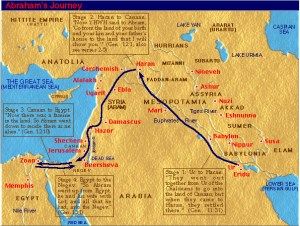
Abraham’s journey
This chapter presents part of the author’s stupendous riff on the theme of faith. It seems as if he provides a decent definition at the outset, but the meanings of the words he uses are notoriously difficult and interpreters have been arguing over them for centuries. The translation quoted above interprets the words psychologically: assurance and conviction are the psychological components of faith. But there’s as good reason to translate, “The reality of things hoped for, the proof of things not seen,” which would assert that faith is just as rational as more worldly views of life. Faith is not a one-way ticket to dreamland; it already experiences what it hopes for and intuits.
But in case the reader should be left arguing the meanings of Greek words, the author gives a long list of biblical characters who illustrate the meaning of faith. The heroes and heroines are those who “trust that God is trustworthy,” for whom the promise of God is as real as bread, even if it demands of them apparently daft actions like building a boat in the countryside or having sex when you’re ninety.
In this passage Abraham is depicted as remaining a nomad because he knew that even Canaan was not journey’s end. That could only be the eternal city of justice designed and built by God. It is easy to assimilate this city to the conventional view of heaven. But I think it means the kingdom of God, heaven and earth together, which many in the first churches believed would come in their lifetimes. All the cities built upon the wealth and violence of humanity lack firm foundations. In the end, as Luther’s great hymn says, only the city of God remains.
This hoped for city becomes real in the adventure of Abraham’s journeying and the justice of his dealings; and he himself becomes a proof that the invisible community exists.
As people live by faith, something of God’s goodness becomes real in the world; and their names can be added to the list in Hebrew’s chapter 11 as proofs of the invisible.
 Emmock's Blog