Here’s a blog which tests out whether the Christain scriptures can provide wisdom for living now. It uses the Episcopal daily readings along with a headline from world news:
Kim Jong-un calls for reconciliation of North and South Korea
Genesis 28:10-22
Jacob’s Dream at Bethel
10 Jacob left Beer-sheba and went towards Haran.11He came to a certain place and stayed there for the night, because the sun had set. Taking one of the stones of the place, he put it under his head and lay down in that place.12And he dreamed that there was a ladder* set up on the earth, the top of it reaching to heaven; and the angels of God were ascending and descending on it.13And the Lord stood beside him* and said, ‘I am the Lord, the God of Abraham your father and the God of Isaac; the land on which you lie I will give to you and to your offspring;14and your offspring shall be like the dust of the earth, and you shall spread abroad to the west and to the east and to the north and to the south; and all the families of the earth shall be blessed* in you and in your offspring.15Know that I am with you and will keep you wherever you go, and will bring you back to this land; for I will not leave you until I have done what I have promised you.’16Then Jacob woke from his sleep and said, ‘Surely the Lord is in this place—and I did not know it!’17And he was afraid, and said, ‘How awesome is this place! This is none other than the house of God, and this is the gate of heaven.’
18 So Jacob rose early in the morning, and he took the stone that he had put under his head and set it up for a pillar and poured oil on the top of it.19He called that place Bethel;* but the name of the city was Luz at the first.20Then Jacob made a vow, saying, ‘If God will be with me, and will keep me in this way that I go, and will give me bread to eat and clothing to wear,21so that I come again to my father’s house in peace, then the Lord shall be my God,22and this stone, which I have set up for a pillar, shall be God’s house; and of all that you give me I will surely give one-tenth to you.’
 Jacob’s name means that he is a Jack-the- lad, a trickster, a chancer (Scots), someone who is always looking to take advantage, and the story of his relationship with his elder brother, Esau (the hulk) demonstrates his ability. He sees the true value of Esau’s status as elder son, tricks his dying father into giving him the elder son’s blessing and gets out of the range of Esau’s rage as fast as he can. Of course he has put himself into danger as a solitary fugitive but he views the blessing as an ace in the hole. Somehow it will give him the edge. In the passage above he undergoes a profound experience of the interconnectedness of earth and heaven. “God is in this place” he says and marks it with a pillar, but like a true traveller he uses the vision to secure God’s company on his journey. Indeed he initiates a covenant with the God he has met. If (1) God will go with him, (2) provide him with food and clothing, (3) bring him back to his family home in peace (=keep Esau at arm’s length) he, Jacob will (1) adopt this God as his God, (2) honour his shrine at Bethel ( Hebrew Beth=house, El=God). (3) give God back one tenth of what God gives him. As a religion it’s almost comically self-seeking, but in fact Jacob has tied himself to an even greater trickster than himself, a God who will trap him and test him and change him, and bring him back in fear to make peace with his wronged brother, so that he can genuinely become a man who will pass on God’s blessing to his children.
The story of Jacob is one of the great stories of all time, especially if it is taken along with the story of his favourite son, Joseph. There is great subtlety in the depiction of human character, but even greater subtlety in the depiction of a God who accepts people as they are in their rough-hewn humanity so that he may shape them to his will.
I find it interesting if a bit alarming to imagine that this is the God who has accompanied me on my life’s journey.
Hebrews 11:13-22
13 All of these died in faith without having received the promises, but from a distance they saw and greeted them. They confessed that they were strangers and foreigners on the earth,14for people who speak in this way make it clear that they are seeking a homeland.15If they had been thinking of the land that they had left behind, they would have had opportunity to return.16But as it is, they desire a better country, that is, a heavenly one. Therefore God is not ashamed to be called their God; indeed, he has prepared a city for them.
17 By faith Abraham, when put to the test, offered up Isaac. He who had received the promises was ready to offer up his only son,18of whom he had been told, ‘It is through Isaac that descendants shall be named after you.’19He considered the fact that God is able even to raise someone from the dead—and figuratively speaking, he did receive him back.20By faith Isaac invoked blessings for the future on Jacob and Esau.21By faith Jacob, when dying, blessed each of the sons of Joseph, ‘bowing in worship over the top of his staff.’22By faith Joseph, at the end of his life, made mention of the exodus of the Israelites and gave instructions about his burial.*
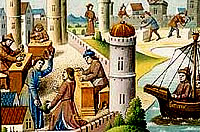
He has prepared a city
(15th cent painting)
Here a brilliant but disorderly thinker of the early Christian community gives his version of the stories of the Old Testament heroes and heroines. The first thing we can see, in contrast to the author of the Jacob stories, is the absence of the sly sense of humour which flavours the ancient tales. Except here and there in the Gospels there’s not much humour in the New Testament, a fact which should put us on our guard.
There is however an ironical note in chapter 11 of Hebrews, which shows that the great heroes of faith acted because they trusted God’s promise of land, or tribal expansion, but were in fact deceiving themselves, because the real attraction was that they would carry with them a blessing of God for all humanity, a homeland not of this world! Their own actions and attitudes show that this was their real motive.
Perhaps many people can identify with the feeling that they are strangers and foreigners on the earth; that the way the world is managed does not satisfy their deepest intuitions about justice, peace and happiness. For all such people the author of Hebrews has a wonderful and extraordinary reassurance: God is not ashamed to be called their God; indeed he has prepared a city for them. Look at the words again. Their implication is that if God had not prepared such a city, he would have been rightly ashamed by the vision and faithfulness of his true worshippers. It is unfortunately true that throughout history there have been leaders who described this city, and came to believe, that as only they could design it and build it, they were justified in getting rid of anyone who disagreed with them. Rather this is the city of which it can truly be said, “Unless the Lord build the house they labour in vain that build it.” It’s not that human beings have no part in building the city, but they can only do so in the humility which lets them listen to God and their brothers and sisters.
Will the city ever be built “in this world”? No, but that does not mean that it will not be built. Indeed St Augustine said of it that it already exists, even in the midst of the human cities of pride and squalor and violence. Those who are strangers and foreigners already belong to this city as they travel and are able to import some of its customs into the world as it is. In face of manifest evils and the humbling knowledge of their own follies, they are sustained by glimpses of the towers and parapets of the city that God has prepared for them.
 Emmock's Blog