We begin the week with the Episcopal daily reading, along with a headline from world news
“Vanguard for protection of Moslems” murders seven hostages in Nigeria

innocent hostages murdered
Romans 7:1-12
An Analogy from Marriage
7Do you not know, brothers and sisters*—for I am speaking to those who know the law—that the law is binding on a person only during that person’s lifetime?2Thus a married woman is bound by the law to her husband as long as he lives; but if her husband dies, she is discharged from the law concerning the husband.3Accordingly, she will be called an adulteress if she lives with another man while her husband is alive. But if her husband dies, she is free from that law, and if she marries another man, she is not an adulteress.
4 In the same way, my friends,* you have died to the law through the body of Christ, so that you may belong to another, to him who has been raised from the dead in order that we may bear fruit for God.5While we were living in the flesh, our sinful passions, aroused by the law, were at work in our members to bear fruit for death.6But now we are discharged from the law, dead to that which held us captive, so that we are slaves not under the old written code but in the new life of the Spirit.<!– 7 –>
The Law and Sin
7 What then should we say? That the law is sin? By no means! Yet, if it had not been for the law, I would not have known sin. I would not have known what it is to covet if the law had not said, ‘You shall not covet.’8But sin, seizing an opportunity in the commandment, produced in me all kinds of covetousness. Apart from the law sin lies dead.9I was once alive apart from the law, but when the commandment came, sin revived10and I died, and the very commandment that promised life proved to be death to me.11For sin, seizing an opportunity in the commandment, deceived me and through it killed me.12So the law is holy, and the commandment is holy and just and good.
 A CLUMSY ANALOGY
This passage begins with a very clumsy analogy drawn from marriage law to explain that a relationship established by law only applies as long as both persons involved are alive. He wants to say that Christian believers have “died” to the religious law and are free from its demands to belong to Jesus. Their lives can now be fruitful for God whereas under the law they produced fruit for death. The new life is not subject to a written code of religious practice but us lived in the freedom of the Spirit.
BACK TO ADAM AND EVE
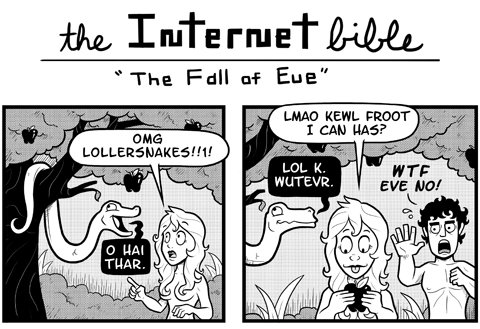
He goes on to describe the way the power of sin, combined with the power of the religious law, brings death. A helpful background to Paul’s thinking on this topic is the Genesis story of Adam and Eve.
Originally they lived in freedom under God, created in God’s likeness. The rule about the Tree of Knowledge was not seen by them as a law, but as provision for their own good, so that they should preserve their immortality. But through the voice of the tempter, which is the voice of their self-deceiving arrogance, the kindly provision is seen as a Law and as a barrier to their self-advancement, and they decide to break it. The Law is just and holy but to human beings in their sinfulness it becomes an occasion for transgression which leads to death. Once they have eaten the fruit they can only “bear fruit for death” for they have become mortal creatures.
WHY IS THERE EVIL IN THE WORLD?
Paul does not try, any more than Genesis does, to explain the origin of the arrogant desire in humanity, which is as foolish as it is destructive: they disobey God in order to become like Gods, when they are already like God in their creation. The Bible simply shows that human beings are like this. Paul confirms that the kindly commandment, meant to lead to life, becomes, through human sin, a means of death. He sees the whole edifice of religious law and practice s a means by which evil may be restrained but not overcome. 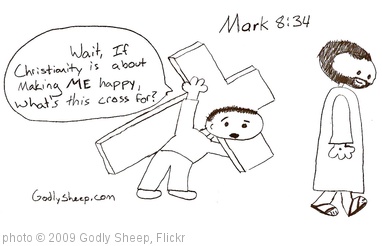
DEATH BEFORE LIFE?
In order, then, to overcome evil, believers must identify with Messiah Jesus, “dying with him on the cross”, condemned by the Law, then rising with him to a new life, in the power of God’s Spirit. (See blog 984 for this transformation). We’ll see how Paul develops this theme in the passages for the rest of this week.
 Emmock's Blog