
This blog wants to represent the Christian faith against all distortions of it (except mine”) by following the Common Lectionary bible readings along with a headline from world news:
Miracle in Cleveland: Disappeared women discovered and freed:

Amnnda Berry (One of the imprisoned women) with sister and niece
Luke 11: 1-13
11 One day it happened that Jesus was praying in a certain place, and after he had finished, one of his disciples said, “Lord, teach us how to pray, as John used to teach his disciples.”
2-4 “When you pray,” returned Jesus, “you should say, ‘Father, may your name be honoured—may your kingdom come! Give us each day the bread we need, and forgive us our sins, for we forgive anyone who owes anything to us; and keep us clear of temptation.’”
The willingness of the Father to answer prayer
5-8 Then he added, “If any of you has a friend, and goes to him in the middle of the night and says, ‘Lend me three loaves, my dear fellow, for a friend of mine has just arrived after a journey and I have no food to put in front of him’; and then he answers from inside the house, ‘Don’t bother me with your troubles. The front door is locked and my children and I have gone to bed. I simply cannot get up now and give you anything!’ Yet, I tell you, that even if he won’t get up and give him what he wants simply because he is his friend, yet if he persists, he will rouse himself and give him everything he needs.”
9-10 And so I tell you, ask and it will be given you, search and you will find, knock and the door will be opened to you. The one who asks will always receive; the one who is searching will always find, and the door is opened to the man who knocks.”
11-13 “Some of you are fathers, and if your son asks you for some fish, would you give him a snake instead, or if he asks you for an egg, would you make him a present of a scorpion? So, if you, for all your evil, know how to give good things to your children, how much more likely is it that your Heavenly Father will give the Holy Spirit to those who ask him!”

Abba in Hebrew script
The shorter version of the “Lord’s Prayer” or “Our father” given by Luke is more or less the same as the longer version minus the explanatory expansions which have been added to the latter.
The address and first petition of the prayer point to God the father. Disciples of Jesus are to begin prayer with the name that Jesus used to address God, “Abba” in his own language, “dear Father” in English. This uses the affectionate trusting relationship of a child to its Jewish father as the metaphor for the disciples’ relationship with God. There has been modern revision that would sometimes substitute “mother” in this prayer for the sake of gender equality, but that’s an error. If Jesus chose to use the relationship with a father rather than the very different (but equally important!) relationship with a mother, then he did so because he thought it more appropriate. To keep Jesus’ meaning we have to keep his word. We may choose, in our own prayers, to address God as dear mother, to emphasise a different aspect of the character of God. I have often done so, but I would not alter the prayer of Jesus. He addresses God with reverence, trust and affection, the first of these words indicating a sense distance that might not be conveyed if he had said “mother.” God is the ultimately distant one, not part of any universe, whose nature is revealed in the impartial love with which he rules the world of nature ( “makes the sun rise on the just and the unjust”) and hopes to persuade human beings to accept also. Jesus’ prayer joins our will to God’s in longing for his rule in our world.
The next three petitions express the shared life of the holy spirit.
We pray for the necessities of daily life for “us” that is, for all creatures. We do not try to secure our future at the expense of others ( daily bread); we do not demand luxuries (bread not steak); and we do not imagine we have earned it (we ask God to give).
We ask for God’s generous forgiveness of our sins (we do not imagine we have no sins); and we acknowledge we can only receive that generous forgiveness as we learn to be generous people. It’s not that God won’t offer it if we are hard-hearted but that we won’t be able to receive it. Until we’ve tried to forgive we’ve no idea what we’re asking of God. The reverse is also true: we won’t have the generosity to forgive others unless we’ve experienced the forgiveness of God. Jesus used the words “owes anything” to remind us that generosity is seamless and applies to material as well as emotional matters.
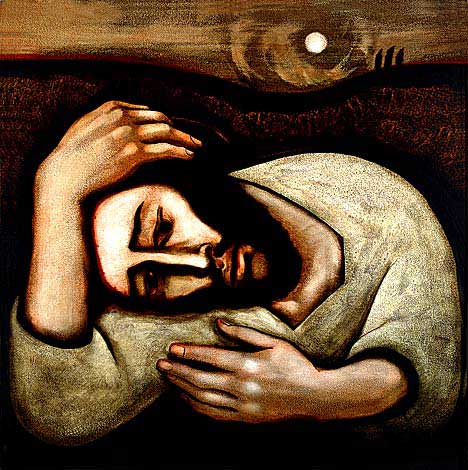
Jesus’ weakness in Gethsemane
Finally, we acknowledge our weakness as disciples. We’re not really up to the job. Faced with trials and temptations we may well fail. Therefore we pray to be spared, as Jesus did in the Garden of Gethsemane, trusting that if we are not spared, as he was not spared, we shall be delivered from evil as he was.
The beginning of the prayer points to God the father, the rest of the prayer points to God the Holy Spirit; the whole prayer is the voice of God the Son. When we pray this prayer we enter the very life of the Holy Trinity as children of God. It is a perfect image of the faith and life of Christian people.
The rest of today’s passage is not an invitation to continuous prayer. It is a encouragement not to give up on prayer when things are hard and God seems distant. If human friends can be badgered into helping us, and human parents give good gifts to their children, will not God, the father of all do much more? The fact that these words were said by a man who ended up on a cross should lead us to think in an adult way about how God answers prayer. My own experience leads me to affirm:
1. God does not answer prayer by supernatural interventions in the processes of the universe.
2. God answers prayer by revealing the gifts he has already given in nature and grace. We come to see that the resources we seek are already present. The development throughout history of medical skill is an instance of this.
3. Beyond the present possibilities of the world God promises his kingdom, which is promised to us beyond death, but which even now is changing the world. The work of international aid agencies in the last 5 years shows how the prayers of starving people can be answered. Greater economic justice would be an even better answer. God works through human beings who respond to his spirit.
 Emmock's Blog