The readings, taken from the Catholic Daily Lectionary, are broadly thematic, but are applied by me to the daily circumstances of my life in Scotland. Other contributions are welcome.
Reading 1, Wis 6:1-11
1 Listen then, kings, and understand; rulers of remotest lands, take warning;
2 hear this, you who govern great populations, taking pride in your hosts of subject nations!
3 For sovereignty is given to you by the Lord and power by the Most High, who will himself probe your acts and scrutinise your intentions.
4 If therefore, as servants of his kingdom, you have not ruled justly nor observed the law, nor followed the will of God,
5 he will fall on you swiftly and terribly. On the highly placed a ruthless judgement falls;
6 the lowly are pardoned, out of pity, but the mighty will be mightily tormented.
7 For the Lord of all does not cower before anyone, he does not stand in awe of greatness, since he himself has made small and great and provides for all alike.
The book of Wisdom was written around the time of Jesus, and shares some of his concerns. Its theology is however oriented to divine qualities of wisdom and justice rather than to the “reign of God.” Its uncompromising message to the rulers of the nations can never have been popular and would probably have little appeal to Tony Blair, George Bush, Osama Bin Laden, Vladimir Putin, or even Silvio Berlusconi. “Sovereignty is given by the Lord” is similar to St. Paul’s phrase in Romans, where he speaks about duty to the authorities, but here it is a warning to the authorities.
As I review my performance as a parent, the passage pushes me to recognise that if all “power ” comes from God, all our behaviour in roles of responsibility is up for judgment, for of all God’s gifts, this is the most likely to be misused. I’m not sure if I relish anyone, far less God, probing my acts and scrutinising my intentions. All the worst things I’ve done, have been done in consciousness of my power.
Gospel, Lk 17:11-19
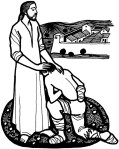
"your trust has made you well"
11 Now it happened that on the way to Jerusalem he was travelling in the borderlands of Samaria and Galilee.
12 As he entered one of the villages, ten men suffering from leprosy came to meet him. They stood some way off
13 and called to him, ‘Jesus! Master! Take pity on us.’
14 When he saw them he said, ‘Go and show yourselves to the priests.’ Now as they were going away they were cleansed.
15 Finding himself cured, one of them turned back praising God at the top of his voice
16 and threw himself prostrate at the feet of Jesus and thanked him. The man was a Samaritan.
17 This led Jesus to say, ‘Were not all ten made clean? The other nine, where are they?
18 It seems that no one has come back to give praise to God, except this foreigner.’
19 And he said to the man, ‘Stand up and go on your way. Your faith has saved you.’
This is how Jesus the King exercises power:
- He makes himself vulnerable by walking in boundary territory and by paying attention to outcast lepers, who show their desperate need by coming to meet him and their heart-breaking discretion by standing at a suitable distance, as they appeal to him.
- Jesus draws no attention to himself. Rather he tells them they are healed (by God), by telling them to have their cure recognised by the village priest.
- Jesus dignifies the man who comes back by his words of appreciation. He attributes the healing to God and the man’s own trust.
He demonstrates how power is given by God for the good of people

