The blog continues to reflect on the Catholic daily bible readings
Reading 1, Zechariah 2:14-17
14 Sing, rejoice, daughter of Zion, for now I am coming to live among you –the Lord declares!
15 And on that day many nations will be converted to the Lord. Yes, they will become his people, and they will live among you. Then you will know that the God of Hosts has sent me to you!
16 The Lord will take possession of Judah, his portion in the Holy Land, and again make Jerusalem his choice.
17 Let all people be silent before the Lord, now that he is stirring from his holy Dwelling!
Luke 1: 26-38
In the sixth month the angel Gabriel was sent by God to a town in Galilee called Nazareth,
27 to a virgin betrothed to a man named Joseph, of the House of David; and the virgin’s name was Mary.
28 He went in and said to her, ‘Rejoice, you who enjoy God’s favour! The Lord is with you.’
29 She was deeply disturbed by these words and asked herself what this greeting could mean,
30 but the angel said to her, ‘Mary, do not be afraid; you have won God’s favour.
31 Look! You are to conceive in your womb and bear a son, and you must name him Jesus.
32 He will be great and will be called Son of the Most High. The Lord God will give him the throne of his ancestor David;
33 he will rule over the House of Jacob for ever and his reign will have no end.’
34 Mary said to the angel, ‘But how can this come about, since I have no knowledge of man?’
35 The angel answered, ‘The Holy Spirit will come upon you, and the power of the Most High will cover you with its shadow. And so the child will be holy and will be called Son of God.
36 And I tell you this too: your cousin Elizabeth also, in her old age, has conceived a son, and she whom people called barren is now in her sixth month,
37 for nothing is impossible to God.’
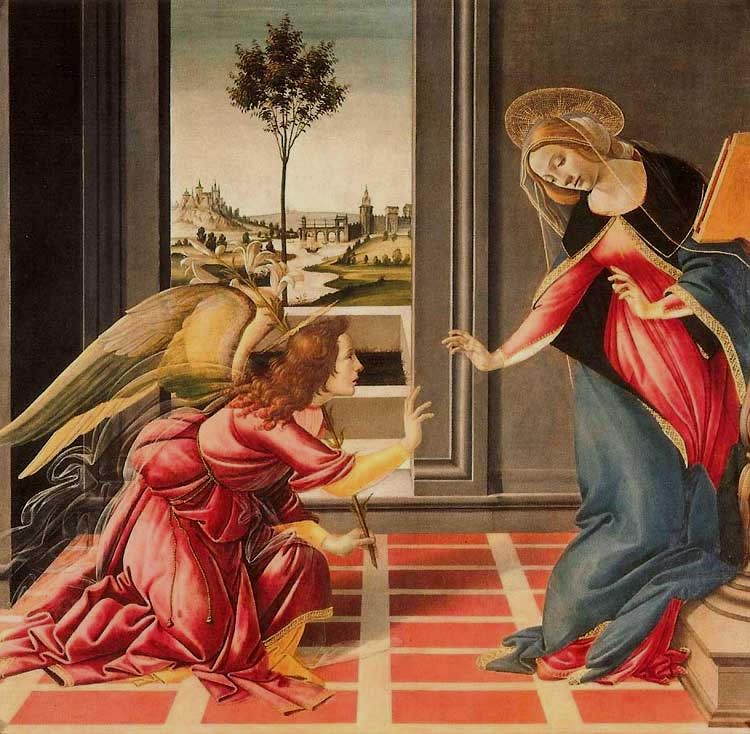
"The Lord is with you!"
38 Mary said, ‘You see before you the Lord’s servant, let it happen to me as you have said.’ And the angel left her.
The easy interpretation would note that Zechariah prophesies God’s dwelling with his people, and Luke tells how this is fulfilled in the birth of Jesus Christ, but maybe we can complicate things a little.
Zechariah lived with the community of Israelites, who had returned from Babylon to Judaea in 539 BCE, and was writing around 520 BCE, when the rebuilding of the Temple was barely begun. Zechariah and his fellow prophet Haggai believed that the rebuilding should be an urgent priority, for the attention of the people. God wants to come and live with them in Jerusalem, but he needs his house repaired. In the past, God dwelling in Zion meant that foreigners would be kept out, but now the prophet tells the people that it will mean foreigners being drawn to worship the God of Israel. They, who had been considered unclean, would dwell amongst the Jews. This aspect of the prophecy may not have been well-received as it was a new thought that the presence of God must also mean the presence of foreigners. In the Torah Jews had been asked to welcome strangers because they had been strangers in Egypt. The presence of God, who loves all races, is a new motive, and one that could apply also to the U.K. authorities, who have persistently allowed the children of asylum seekers to be put in prison. The presence of the universal God is an awe-inspiring event.
The coming of the Son of God also inspires awe. For this reason Luke adopts the age-old style of the narratives of Abraham, Isaac and Jacob, to tell the story of Mary. In this style, the mystery and dignity of the eternal God, who speaks through his angel, is matched by the dignity of the woman who will “conceive in her womb” (she does not become “pregnant”) and bear a son although she has “no knowledge of man” (not, “never had sex.”) This style makes sure that the reader is faced with the irreducibly personal nature of God’s action. God’s salvation is not a general offer, it is a specific action involving a particular person at a definite time and place. It is therefore totally dependent on the co-operation of Mary. She could have stopped the incarnation in its tracks. Anyone who has reluctantly come to the conclusion, that God is asking something of them, will find this passage challenging. Mary’s agreement is without reserve and passionate, “I am the Lord’s slave-girl.”

