
This blog follows the daily bible readings of the Catholic Church
Reading 1, Hosea 10:1-3, 7-8, 12
1 Israel was a luxuriant vine yielding plenty of fruit. The more his fruit increased, the more altars he built; the richer his land became, the richer he made the sacred pillars.
2 Theirs is a divided heart; now they will have to pay for it. He himself will hack down their altars and wreck their sacred pillars.
3 Then they will say, ‘We have no king because we have not feared the Lord, but what could the king do for us?’
7 Samaria has had her day. Her king is like a straw drifting on the water.
8 The high places of Aven, the sin of Israel, will be destroyed; thorns and thistles will grow over their altars. Then they will say to the mountains, ‘Cover us!’ and to the hills, ‘Fall on us!’
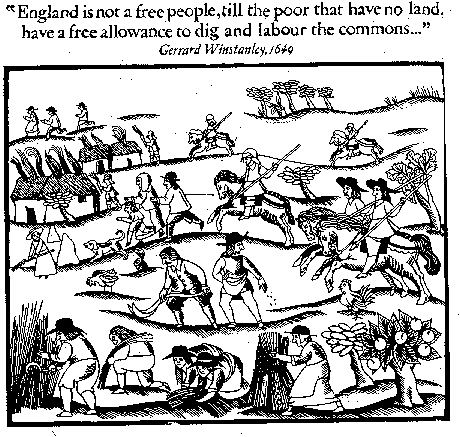
Sow Justice-a Digger image from 1649
12 Sow saving justice for yourselves, reap a harvest of faithful love; break up your fallow ground: it is time to seek out Yahweh until he comes to rain saving justice down on you.
The uncertain text of Hosea’s prophecy is not helped by the Lectionary’s selection of verses. As this stands, the prophet judges his people because they misused God’s favour in good times and worshipped idols. The altars on the tops of rocks (high places) will be destroyed (presumably by invading armies). Samaria/Israel is the one nation. The monarchy will be powerless.
The only positive aspect of the prophecy is the command to sow justice so that there will be a harvest of faithful love, that is, the covenant love binding Israel to her God, and God to Israel. Just as ploughed land waits for and receives rain, so a people who practice justice will be ready to receive the rescuing justice of God. This is another form of the gospel announcements that the measure we give will be the measure we receive; and that our readiness to forgive will determine our capacity to be forgiven. God first turns to us, but we must turn towards his goodness, before we can receive his love. There’s an irreducible harshness in God’s love: God will not “do it for us”, we must choose.
Gospel, Matthew 10:1-7
1 He summoned his twelve disciples and gave them authority over unclean spirits with power to drive them out and to cure all kinds of disease and all kinds of illness.
2 These are the names of the twelve apostles: first, Simon who is known as Peter, and his brother Andrew; James the son of Zebedee, and his brother John; 3 Philip and Bartholomew; Thomas, and Matthew the tax collector; James the son of Alphaeus, and Thaddaeus; 4 Simon the Zealot and Judas Iscariot, who was also his betrayer.
5 These twelve Jesus sent out, instructing them as follows: ‘Do not make your way to gentile territory, and do not enter any Samaritan town; 6 go instead to the lost sheep of the House of Israel. 7 And as you go, proclaim that the kingdom of Heaven is close at hand.
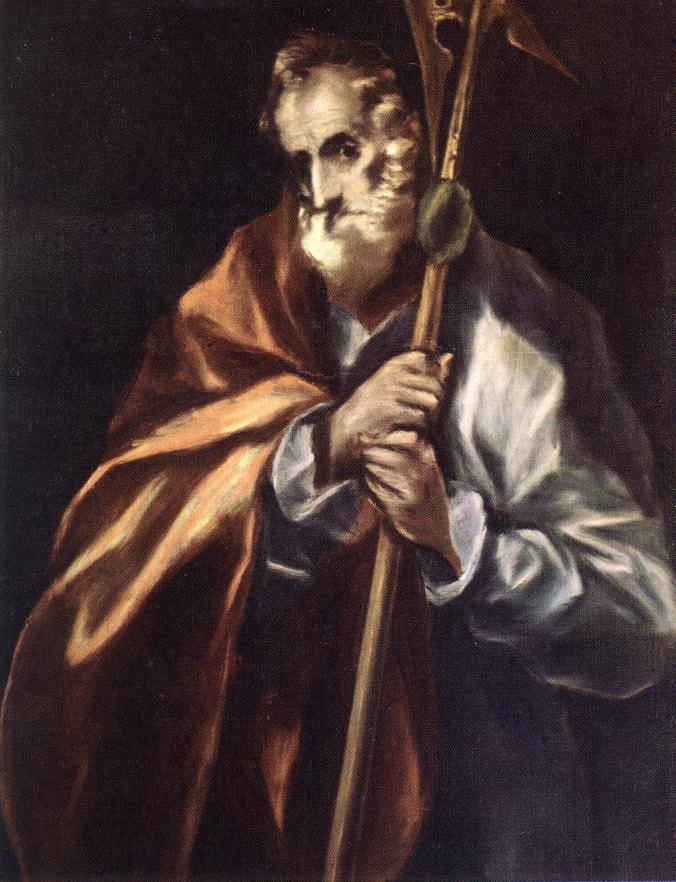
Thaddaeus, the unknown disciple
God’s turns to his people in the ministry of Jesus, by the announcement of the kingdom and the healing of disease. The hope that Israel will respond is embodied in the symbol of the Twelve Disciples who stand for the twelve tribes. They have already turned towards God’s goodness and have received God’s love through Jesus. Although the concept of the Twelve is symbolic, these are real people, with personal histories, some of which are noted: Simon the Rock, Matthew the tax collector, Simon the Zealot. I like Thaddaeus, as nothing at all is known of him, either in the bible or outside it. Some scholars have identified him with Jude, but this is unconvincing. Perhaps he did nothing that made him famous. If so, he stands with all the rest of us who’ve never done anything very much, except try to follow Jesus, whose names are recorded only, by the grace of God, in the book of life.

