
This blog follows the daily bible readings of the Catholic Church
Reading 1, Titus 3:1-7 
1 Remind them to be obedient to the officials in authority; to be ready to do good at every opportunity; 2 not to go slandering other people but to be peaceable and gentle, and always polite to people of all kinds. 3 There was a time when we too were ignorant, disobedient and misled and enslaved by different passions and dissipations; we lived then in wickedness and malice, hating each other and hateful ourselves.4 But when the kindness and love of God our Saviour for humanity were revealed,
5 it was not because of any upright actions we had done ourselves; it was for no reason except his own faithful love that he saved us, by means of the cleansing water of rebirth and renewal in the Holy Spirit 6 which he has so generously poured over us through Jesus Christ our Saviour; 7 so that, justified by his grace, we should become heirs in hope of eternal life.

Often criticised for being too peaceful
Reading this letter sent in the name of Paul, it’s easy to feel that something has been lost: a passionate struggle for truth and depth of social/psychological insight have flattened out into a decent, law-abiding, modest religion. Still, when we see what terrors can be unleashed on the world by religious passion, we may be more inclined to value the kind of faith expressed here. Patience, peacefulness, gentleness and modesty are attractive virtues which have allowed dissident communities to survive in hostile environments, as for example, Christians in Iraq before the crises of the last ten years, or indeed with very few exceptions, Moslems in the U.K.
Gospel, Luke 17:11-19
11 Now it happened that on the way to Jerusalem he was travelling in the borderlands of Samaria and Galilee. 12 As he entered one of the villages, ten men suffering from a virulent skin-disease came to meet him. They stood some way off 13 and called to him, ‘Jesus! Master! Take pity on us.’
14 When he saw them he said, ‘Go and show yourselves to the priests.’ Now as they were going away they were cleansed.
15 Finding himself cured, one of them turned back praising God at the top of his voice 16 and threw himself prostrate at the feet of Jesus and thanked him. The man was a Samaritan.
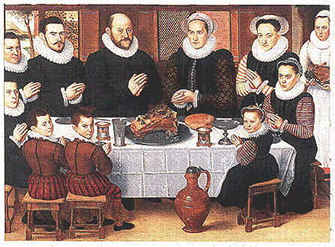
Thanks before food in 17th century Holland
17 This led Jesus to say, ‘Were not all ten made clean? The other nine, where are they?18 It seems that no one has come back to give praise to God, except this foreigner.’ 19 And he said to the man, ‘Stand up and go on your way. Your faith has saved you.’
While the (presumably Jewish) lepers take their healing as good fortune, or as what you expect from a prophet, the Samaritan is struck with wonder and gratitude. The story reminds the diligent reader of Luke of the incident at Nazareth where Jesus told his hearers that Elijah and Elisha were only sent to foreigners. Now, although Jesus has ministered to his own people, only a foreigner understands the source of his power and praises God.
Familiarity with religion can dull a person’s response to God’s blessing.
Gratitude is a lovely virtue and the mother of many others. The grateful person will often be generous, kind and compassionate. Taking good things for granted, or worse, imagining that we have earned or are entitled to them, is one of the roots of greed and injustice.
 Emmock's Blog