
This blog follows the daily bible readings of the Catholic Church
Reading 1, Philemon 7-20
7 I have received much joy and encouragement by your love; you have set the hearts of God’s holy people at rest. 8 Therefore, although in Christ I have no hesitations about telling you what your duty is, 9 I am rather appealing to your love, being what I am, Paul, an old man, and now also a prisoner of Christ Jesus. 10 I am appealing to you for a child of mine, whose father I became while wearing these chains: I mean Onesimus. 11 He was of no use to you before, but now he is useful both to you and to me.
12 I am sending him back to you — that is to say, sending you my own heart. 13 I should have liked to keep him with me; he could have been a substitute for you, to help me while I am in the chains that the gospel has brought me. 14 However, I did not want to do anything without your consent; it would have been forcing your act of kindness, which should be spontaneous. 15 I suppose you have been deprived of Onesimus for a time, merely so that you could have him back for ever, 16 no longer as a slave, but something much better than a slave, a dear brother; especially dear to me, but how much more to you, both on the natural plane and in the Lord.
17 So if you grant me any fellowship with yourself, welcome him as you would me; 18 if he has wronged you in any way or owes you anything, put it down to my account. 19 I am writing this in my own hand: I, Paul, shall pay it back — I make no mention of a further debt, that you owe your very self to me! 20 Well then, brother, I am counting on you, in the Lord; set my heart at rest, in Christ.
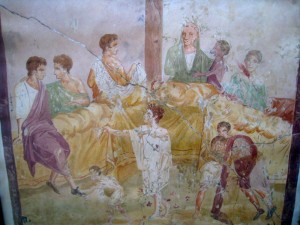
In Roman art, slaves are shown as small
This letter is one of Paul’s masterpieces. He is writing to a member of the church in Colossae, asking him to free a runaway slave, Onesimus (“Handy”), who has meantime become a believer and has been helping Paul in his Ephesus imprisonment. Underneath the text of the letter runs another text: the story of God’s grace in Christ. Omesimus is like a son to Paul, who is therefore like a father who sends his son into danger but hopes to have him back. Like God, Paul could command obedience but prefers to seek a willing response. Like Jesus, Paul will take upon himself any debt owed by the “sinner” Onesimus. It’s not clear how much of this is consciously intended by Paul and how much us due to his own immersion in the gospel.
We don’t know what Paul thought of slavery as an institution, but we do know that he worked to build a community where there would be neither slave nor free but all would be one in Christ. We can see in this letter what “in Christ” means: that the partnership of Christian people should be based on the story of their own salvation, that is, on nothing less than the saving justice and generosity of God.
The church may not always be able to change evil institutions in society; but it can always make sure that its own communal life offers a clear alternative.
Gospel, Luke 17:20-25
20 Asked by the Pharisees when the kingdom of God was to come, he gave them this answer, ‘The coming of the kingdom of God does not admit of observation 21 and there will be no one to say, “Look, it is here! Look, it is there!” For look, the kingdom of God is among you.’
22 He said to the disciples, ‘A time will come when you will long to see one of the days of the Son of man and will not see it. 23 They will say to you, “Look, it is there!” or, “Look, it is here!” Make no move; do not set off in pursuit; 24 for as the lightning flashing from one part of heaven lights up the other, so will be the Son of man when his Day comes.25 But first he is destined to suffer grievously and be rejected by this generation.
 The Son of Man is used by Luke as a term which means “Jesus and his people.” It always refers to Jesus as the leader of a new people. Jesus is depicted as warning disciples to beware of those who run about saying the last days have arrived. When God decides to wrap up the show, it’ll be evident enough. Until then, God’s people should be content with the fact that God’s direct rule has already arrived in their communal life. Until the time of deliverance, those who belong to the Son of Man will share his sufferings.
Maybe most of us today are less tempted to make premature announcements of the coming of the Kingdom, than we are to dismiss it altogether, doubting if even God can bring history to a just conclusion. I think that although we may struggle to articulate it, a vision of the triumph of the long-suffering Son of Man, of the lightning flashing across the sky, is necessary for our faith.

