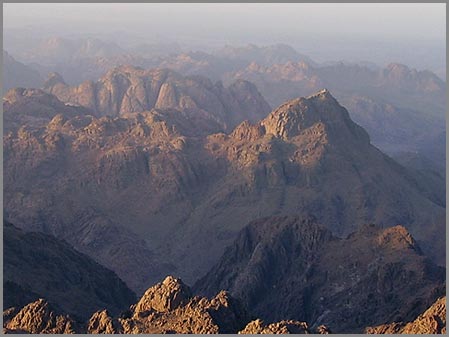
Sinai
This blog follows the daily bible readings of the Catholic Church
Reading 1, Isaiah 25:6-10a
6 On this mountain, for all peoples, the Lord of Armies is preparing a banquet of rich food, a banquet of fine wines, of succulent food, of well-strained wines.
7 On this mountain, he has destroyed the veil which used to veil all peoples, the pall enveloping all nations;
8 he has destroyed death for ever. Our Lord has wiped away the tears from every cheek; he has taken his people’s shame away everywhere on earth, for the Lord has spoken.
9 And on that day, it will be said, ‘Look, this is our God, in him we put our hope that he should save us, this is the Lord, we put our hope in him. Let us exult and rejoice since he has saved us.’
10 For the Lord’s hand will rest on this mountain, and Moab will be trodden under his feet as straw is trodden into the dung-heap.
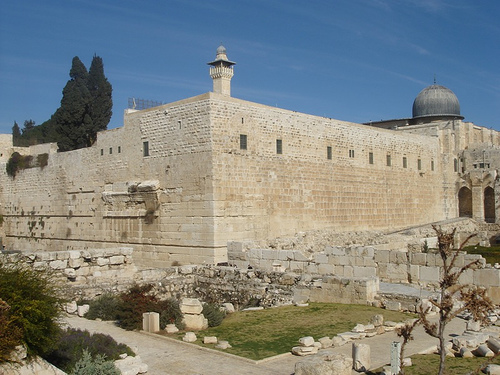
Temple in Jerusalem
Gospel, Matthew 15:29-37
29 Jesus went on from there and reached the shores of the Lake of Galilee, and he went up onto the mountain. He took his seat, 30 and large crowds came to him bringing the lame, the crippled, the blind, the dumb and many others; these they put down at his feet, and he cured them.
31 The crowds were astonished to see the dumb speaking, the cripples whole again, the lame walking and the blind with their sight, and they praised the God of Israel.
32 But Jesus called his disciples to him and said, ‘I feel sorry for all these people; they have been with me for three days now and have nothing to eat. I do not want to send them off hungry, or they might collapse on the way.’
33 The disciples said to him, ‘Where in a deserted place could we get sufficient bread for such a large crowd to have enough to eat?’
34 Jesus said to them, ‘How many loaves have you?’ They said, ‘Seven, and a few small fish.’ 35 Then he instructed the crowd to sit down on the ground, 36 and he took the seven loaves and the fish, and after giving thanks he broke them and began handing them to the disciples, who gave them to the crowds. 37 They all ate as much as they wanted, and they collected what was left of the scraps, seven baskets full.
Biblical mountains mean revelation; and as the literature was edited and circulated, “mountain stories” were seen to reflect each other. Isaiah’s prophecy is one of a whole series about Zion, the hill of the Temple, the sign that God dwells with his people. Its destruction is often prophesied by the eighth century B.C. prophets, as a sign of God’s withdrawal from his unfaithful people and of his anger towards them. Conversely it appears in later visions, such as the one above, of a renewed temple, to which all nations shall have access, as they live together in peace. This vision is part of a set of prophecies attributed to Isaiah, but from a much later time, which envisage a moment beyond history when God will conquer evil and death, and share his victory banquet with humanity. This is the earliest scripture in which we find the beautiful detail of God, as mother, wiping the tears from the children’s faces. This gracious hope is marred by the insistence that the heathen neighbour, Moab, will be humiliated, as if a vision of Scotland radiant in justice and natural beauty as the centre of a restored earth, were to include the detail, “and the English will be gubbed.”
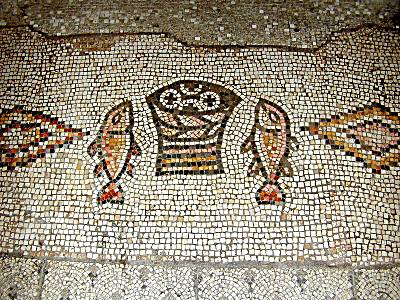
4th century Roman mosaic of the fish and bread
Matthew’s mountain, where Jesus feeds the people, reflects Isaiah’s mountain banquet, as well as Moses’ Mount Sinai where the Torah, God’s Law, was given. The event is however very down- to- earth compared with either of these: here are no gathered nations, but crowds of crippled, blind and lame people, who are healed; death is not destroyed but compassion is made effective; the banquet is not produced as from nothing but from the meagre resources of the disciples; nobody is rejected or destroyed. Although there is a miraculous element to the story, Matthew emphasises its location in the everyday world. Jesus’ Way is possible within history: why wait until doomsday to wipe away the tears? Here and now the sick can be healed; here and now the hungry can be fed; here and now those who follow Jesus will find that their meagre resources are more than adequate when blessed by the Lord.
 Emmock's Blog
“Jesus’ Way is possible within history.”
It is true. We can’t bring down the kingdom of God, but we are called to live up to that portion of it which we have received.
Thanks Jeff. No, the kingdom itself is not realisable within history, but the Way to the kingdom is a “portion” of it, which we can receive. All the way to the kingdom is the kingdom.
We have Canadian snow here at present: deep stuff which increases from day to day. Because we’re not prepared the nation grinds to a halt.