“U.S. REPUBLICANS TO USE CONGRESS TO DESTROY HEALTH CARE LEGISLATION”
This blog provides a daily meditation on the Revised Common Lectionary readings along with a headline from world news
Exodus 3:1-12
Moses at the Burning Bush
3Moses was keeping the flock of his father-in-law Jethro, the priest of Midian; he led his flock beyond the wilderness, and came to Horeb, the mountain of God. 2There the angel of the Lord appeared to him in a flame of fire out of a bush; he looked, and the bush was blazing, yet it was not consumed. 3Then Moses said, ‘I must turn aside and look at this great sight, and see why the bush is not burned up.’ 4When the Lord saw that he had turned aside to see, God called to him out of the bush, ‘Moses, Moses!’ And he said, ‘Here I am.’ 5Then he said, ‘Come no closer! Remove the sandals from your feet, for the place on which you are standing is holy ground.’ 6He said further, ‘I am the God of your father, the God of Abraham, the God of Isaac, and the God of Jacob.’ And Moses hid his face, for he was afraid to look at God.
7 Then the Lord said, ‘I have observed the misery of my people who are in Egypt; I have heard their cry on account of their taskmasters. Indeed, I know their sufferings, 8and I have come down to deliver them from the Egyptians, and to bring them up out of that land to a good and broad land, a land flowing with milk and honey, to the country of the Canaanites, the Hittites, the Amorites, the Perizzites, the Hivites, and the Jebusites. 9The cry of the Israelites has now come to me; I have also seen how the Egyptians oppress them. 10So come, I will send you to Pharaoh to bring my people, the Israelites, out of Egypt.’ 11But Moses said to God, ‘Who am I that I should go to Pharaoh, and bring the Israelites out of Egypt?’ 12He said, ‘I will be with you; and this shall be the sign for you that it is I who sent you: when you have brought the people out of Egypt, you shall worship God on this mountain.’
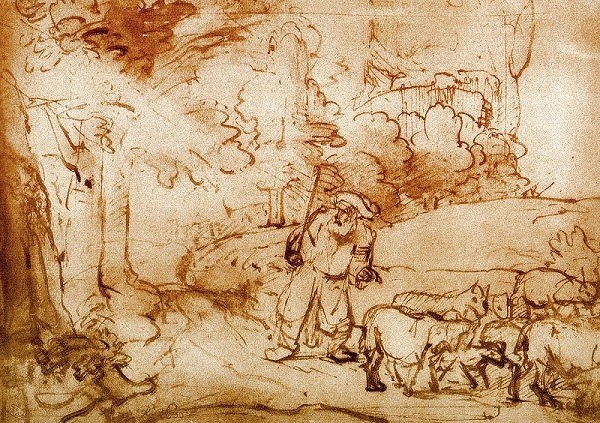
Rembrandt shows Moses becoming the shepherd of his people
John 1:35-42
The First Disciples of Jesus
35 The next day John again was standing with two of his disciples, 36and as he watched Jesus walk by, he exclaimed, ‘Look, here is the Lamb of God!’ 37The two disciples heard him say this, and they followed Jesus. 38When Jesus turned and saw them following, he said to them, ‘What are you looking for?’ They said to him, ‘Rabbi’ (which translated means Teacher), ‘where are you staying?’ 39He said to them, ‘Come and see.’ They came and saw where he was staying, and they remained with him that day. It was about four o’clock in the afternoon. 40One of the two who heard John speak and followed him was Andrew, Simon Peter’s brother. 41He first found his brother Simon and said to him, ‘We have found the Messiah’ (which is translated Anointed*). 42He brought Simon* to Jesus, who looked at him and said, ‘You are Simon son of John. You are to be called Cephas’ (which is translated Peter).
There is a world of difference between the atmospheric account of the call of Moses and the laconic narrative of the call of Andrew and Simon. In the first, God’s presence is dramatised by the burning bush which is a sign of the inexhaustible energy of God and of his fiery presence in his servants: Moses too will burn but will not be consumed. The author of this passage puts into God’s mouth a fundamental expression of Israelite faith, “I have heard the cry of my people and have come down to deliver them.” God “comes down” through the inspiration of his prophet, Moses, who communicates God’s word to his people and their enemies. The story of Moses has inspired many Christian rebellions against injustice. The provision of decent health care for all citizens might be seen as a prosaic example of God hearing the cries of the people and coming down to deliver them. Certainly in the U.K. those who can remember the fear of having to pay doctor’s bills, view the National Health Service as deliverance. Large numbers of Christian people in the USA want to destroy the tentative moves made by the administration towards medical justice. They have crafted their Christian faith into an instrument of oppression and neglected the call of God. They have allowed their hatred of big government (which may be quite legitimate) to blind them to the needs of the poor.

The Doctor's bill
However powerful God may be, He needs the cooperation of human beings to do His justice in the world. To those who respond to his call, God promises, “I will be with you.”
John’s account of Jesus’ call to Andrew and Simon (and an unnamed disciple of John the Baptist!) is full of subtleties: Jesus is called “the lamb of God” a title formed from Passover lambs and the sheep led to the slaughter, indicating Jesus’ costly victory over evil; He asks the men, “What are you looking for? (What do you seek?) a fundamental question about the orientation of their lives; they ask where He stays (the Greek verb menein which John uses to designate Jesus’ abiding with God); Jesus invites them to come and see (a foretaste of their whole experience of discipleship); it is the tenth hour (traditionally, the hour after Jesus’ death on the cross); as a result, they state their belief that Jesus is the Messiah. The passage tells me that to know Jesus as Messiah is to know that he will suffer rejection and death because he abides with God; and that only by abiding with him can I satisfy my search for truth. Through discipleship even the one who starts out as “Rocky” can become a true rock.
 Emmock's Blog
I do thank God for Canada’s health care, which was inaugerated by a Baptist minister turned politician.
Pardon my ignorance though – what do the astericks (*) signify in the text?
Happy New Year, Jeff! Good to hear you. The U.K Health Servce was pioneered by Aneurin Bevan, socialist and product of Welsh Methodism. Christian influence on health care is of course very prominent through missions in various parts of the world. Building these provisions into the economies of modern states is a vital task still. Maintaining them against commercial intrusion is becoming important in the U.K. now.
Asterisks in the text! I’m using a new text NRSV from Oremus Bible Browser where the asterisks mark terms which are explained in their glossary. I meant to remove them from the blog version.