GADAFFI SON KILLED IN AIR STRIKE? 
This blog provides a meditation on the Episcopal daily readings along with a headline from world news
2 Samuel 12:15-31
15Then Nathan went to his house.
The Lord struck the child that Uriah’s wife bore to David, and it became very ill. 16David therefore pleaded with God for the child; David fasted, and went in and lay all night on the ground. 17The elders of his house stood beside him, urging him to rise from the ground; but he would not, nor did he eat food with them. 18On the seventh day the child died. And the servants of David were afraid to tell him that the child was dead; for they said, ‘While the child was still alive, we spoke to him, and he did not listen to us; how then can we tell him the child is dead? He may do himself some harm.’ 19But when David saw that his servants were whispering together, he perceived that the child was dead; and David said to his servants, ‘Is the child dead?’ They said, ‘He is dead.’ 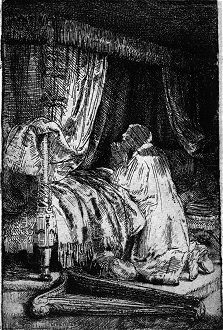
20 Then David rose from the ground, washed, anointed himself, and changed his clothes. He went into the house of the Lord, and worshipped; he then went to his own house; and when he asked, they set food before him and he ate. 21Then his servants said to him, ‘What is this thing that you have done? You fasted and wept for the child while it was alive; but when the child died, you rose and ate food.’ 22He said, ‘While the child was still alive, I fasted and wept; for I said, “Who knows? The Lord may be gracious to me, and the child may live.” 23But now he is dead; why should I fast? Can I bring him back again? I shall go to him, but he will not return to me.’
24 Then David consoled his wife Bathsheba, and went to her, and lay with her; and she bore a son, and he named him Solomon. The Lord loved him, 25and sent a message by the prophet Nathan; so he named him Jedidiah because of the Lord.
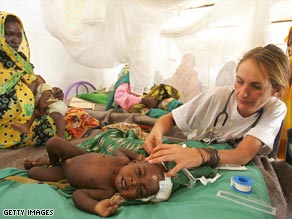
the greatest in the kingdom
Mark 9:30-41
30 They went on from there and passed through Galilee. He did not want anyone to know it; 31for he was teaching his disciples, saying to them, ‘The Son of Man is to be betrayed into human hands, and they will kill him, and three days after being killed, he will rise again.’ 32But they did not understand what he was saying and were afraid to ask him.
33 Then they came to Capernaum; and when he was in the house he asked them, ‘What were you arguing about on the way?’ 34But they were silent, for on the way they had argued with one another about who was the greatest. 35He sat down, called the twelve, and said to them, ‘Whoever wants to be first must be last of all and servant of all.’ 36Then he took a little child and put it among them; and taking it in his arms, he said to them, 37‘Whoever welcomes one such child in my name welcomes me, and whoever welcomes me welcomes not me but the one who sent me.’
38 John said to him, ‘Teacher, we saw someone casting out demons in your name, and we tried to stop him, because he was not following us.’ 39But Jesus said, ‘Do not stop him; for no one who does a deed of power in my name will be able soon afterwards to speak evil of me. 40Whoever is not against us is for us. 41For truly I tell you, whoever gives you a cup of water to drink because you bear the name of Christ will by no means lose the reward.
If we compare these to readings we’ll notice a crucial difference: in the first the underlying theological assumption is that if God loves you, you will prosper, even if He has to punish you; whereas in the second, that very assumption is challenged. God helps David to the throne and keeps faith with him even when he sins; whereas Jesus, the beloved of God, the spiritual successor of David, is asked to suffer and die. David is upwardly mobile and concerned about status, whereas the followers of Jesus are asked to welcome the littlest and the least and to forget status. David finds shrewd ways of dealing with those who don’t support him, whereas Jesus is happy for outsiders to use his name in the battle against disease.
The difference is so clear that we could assume Christian believers should adopt Jesus’ theology and forget the other. But the Christian Church decided, not without debate, to keep the Jewish scripture as part of its holy book. This decision requires us to keep the story of Jesus in tension with the stories from the Jewish Bible. By so doing we notice that David’s faith is similar to that of Jesus, in that it is a relationship of love, not bound by convention but capable of trying to change God’s mind, (David pleads for his child, Jesus asks that the cup should pass from him), yet accepting what happens as God’s requirement. The nobility of Jesus when he puts his arms round a child and insists on his/her importance is paralleled by the nobility of David who accepts that his child is dead but he, David, is still alive: “I shall go to him, but he will not return to me.”
Mark’s theology is utterly different from that of the Samuel author, just as we may suppose, the theology of Jesus was different from David’s; but the humanity depicted is not so different. In the light of the one (The Gospel), we can learn how to find nourishment in the other. Jesus said that he’d come to fulfil the Torah, not to destroy it.
 Emmock's Blog