
POLITICAL PRAYER RALLY IN USA

"Do not be like the hypocrites who like to pray in public." -Jesus
This blog provides a meditation on the Episcopal daily readings along with a headline from world news
2 Samuel 13:23-39
23 After two full years Absalom had sheepshearers at Baal-hazor, which is near Ephraim, and Absalom invited all the king’s sons. 24Absalom came to the king, and said, ‘Your servant has sheepshearers; will the king and his servants please go with your servant?’ 25But the king said to Absalom, ‘No, my son, let us not all go, or else we will be burdensome to you.’ He pressed him, but he would not go but gave him his blessing. 26Then Absalom said, ‘If not, please let my brother Amnon go with us.’ The king said to him, ‘Why should he go with you?’ 27But Absalom pressed him until he let Amnon and all the king’s sons go with him. Absalom made a feast like a king’s feast. 28Then Absalom commanded his servants, ‘Watch when Amnon’s heart is merry with wine, and when I say to you, “Strike Amnon”, then kill him. Do not be afraid; have I not myself commanded you? Be courageous and valiant.’ 29So the servants of Absalom did to Amnon as Absalom had commanded. Then all the king’s sons rose, and each mounted his mule and fled.
30 While they were on the way, the report came to David that Absalom had killed all the king’s sons, and not one of them was left. 31The king rose, tore his garments, and lay on the ground; and all his servants who were standing by tore their garments. 32But Jonadab, the son of David’s brother Shimeah, said, ‘Let not my lord suppose that they have killed all the young men the king’s sons; Amnon alone is dead. This has been determined by Absalom from the day Amnon raped his sister Tamar. 33Now therefore, do not let my lord the king take it to heart, as if all the king’s sons were dead; for Amnon alone is dead.’
34 But Absalom fled. When the young man who kept watch looked up, he saw many people coming from the Horonaim road by the side of the mountain. 35Jonadab said to the king, ‘See, the king’s sons have come; as your servant said, so it has come about.’ 36As soon as he had finished speaking, the king’s sons arrived, and raised their voices and wept; and the king and all his servants also wept very bitterly.
37 But Absalom fled, and went to Talmai son of Ammihud, king of Geshur. David mourned for his son day after day. 38Absalom, having fled to Geshur, stayed there for three years. 39And the heart of the king went out, yearning for Absalom; for he was now consoled over the death of Amnon.

character is destiny- if we don't change
The reader who has followed the story feels little pity for Amnon who has planned and carried out the cold-blooded rape of his half sister Tamar. It’s clear that Amnon is a marked man, although the delayed revenge may have given him cause for complacency. David’s fear that all his sons have been killed is evidence of his lurking fear that Nathan’s prophecy about trouble in his family has come true in spades. In fact Absalom has used his general invitation to the princes as cover for his design on Amnon. David’s own lack of a proper commitment to justice is shown in his longing for Absalom and his readiness to accept what he has done. The author expresses neither condemnation of David nor pity for him. The story exposes the king’s predicament and wants us to remember how it has been caused, that is, by David’s murder of Uriah and his theft of his wife. Actions may be repented and forgiven but in this narrative no one can escape the consequences of their character.
Mark 9:42-50
42 ‘If any of you put a stumbling-block before one of these little ones who believe in me, it would be better for you if a great millstone were hung around your neck and you were thrown into the sea. 43If your hand causes you to stumble, cut it off; it is better for you to enter life maimed than to have two hands and to go to hell, to the unquenchable fire. 45And if your foot causes you to stumble, cut it off; it is better for you to enter life lame than to have two feet and to be thrown into hell 47And if your eye causes you to stumble, tear it out; it is better for you to enter the kingdom of God with one eye than to have two eyes and to be thrown into hell, 48where their worm never dies, and the fire is never quenched.
49 ‘For everyone will be salted with fire. 50Salt is good; but if salt has lost its saltiness, how can you season it? Have salt in yourselves, and be at peace with one another.’
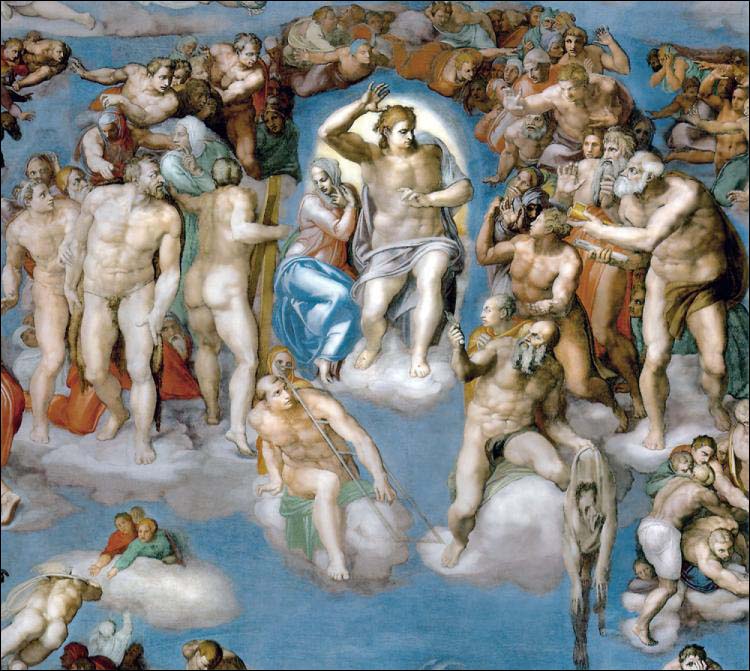
Michelangelo's Jesus in judgement
The “good news” of the kingdom requires ruthlessness in dealing with one’s own character. Weaknesses and faults are not to be tolerated, (as David tolerated them). No human capacities are so important that they cannot be thrown away if they bring a person into evil. This is completely contrary to the morality of our time which insists that all human capacity is precious and must be rescued rather than rejected. The desire and capacity to gain wealth, for example, although we admit it can lead a person into evil, is thought to be precious in itself and worth preserving. Jesus teaches otherwise: whatever leads us into evil has to be excised, like a cancer. Failure to eradicate the aspects of ourselves which bring us into evil, will bring us into the pains of hell. Jesus’ words about hell are capable of many interpretations but should not be ignored as if unworthy of Him. Of course God forgives; but his forgiveness is for the sake of our new selves, not an excuse to remain as we are.
(In verses 59, 50 it seem to me that Mark has brought together three unrelated remarks of Jesus about salt.)

