
TEENAGE RIOTERS DISRUPT LONDON
This blog provides a meditation on the Episcopal daily readings aloing with a headline from world news
2 Samuel 14:1-20
14Now Joab son of Zeruiah perceived that the king’s mind was on Absalom. 2Joab sent to Tekoa and brought from there a wise woman. He said to her, ‘Pretend to be in mourning; put on mourning garments, do not anoint yourself with oil, but behave like a woman who has been mourning many days for the dead. 3Go to the king and speak to him as follows.’ And Joab put the words into her mouth.
4 When the woman of Tekoa came to the king, she fell on her face to the ground and did obeisance, and said, ‘Help, O king!’ 5The king asked her, ‘What is your trouble?’ She answered, ‘Alas, I am a widow; my husband is dead. 6Your servant had two sons, and they fought with one another in the field; there was no one to part them, and one struck the other and killed him. 7Now the whole family has risen against your servant. They say, “Give up the man who struck his brother, so that we may kill him for the life of his brother whom he murdered, even if we destroy the heir as well.” Thus they would quench my one remaining ember, and leave to my husband neither name nor remnant on the face of the earth.’
8 Then the king said to the woman, ‘Go to your house, and I will give orders concerning you.’ 9The woman of Tekoa said to the king, ‘On me be the guilt, my lord the king, and on my father’s house; let the king and his throne be guiltless.’ 10The king said, ‘If anyone says anything to you, bring him to me, and he shall never touch you again.’ 11Then she said, ‘Please, may the king keep the Lord your God in mind, so that the avenger of blood may kill no more, and my son not be destroyed.’ He said, ‘As the Lord lives, not one hair of your son shall fall to the ground.’
12 Then the woman said, ‘Please let your servant speak a word to my lord the king.’ He said, ‘Speak.’ 13The woman said, ‘Why then have you planned such a thing against the people of God? For in giving this decision the king convicts himself, inasmuch as the king does not bring his banished one home again. 14We must all die; we are like water spilled on the ground, which cannot be gathered up. But God will not take away a life; he will devise plans so as not to keep an outcast banished for ever from his presence.
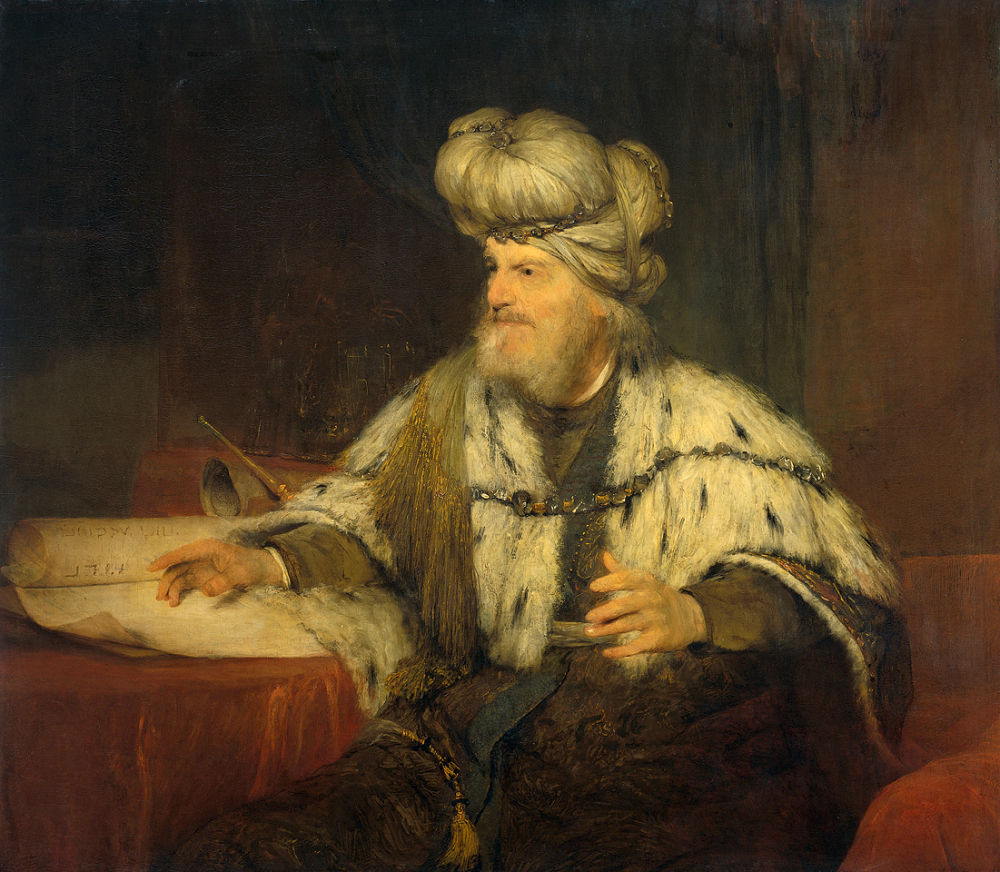
King David-moral ambiguity
Joab is a shrewd man who knows that David needs some encouragement to do what is already in his heart. He uses the same device as Nathan the prophet used in his story of the poor man’s lamb: he invents a story which allows David to see his own situation in the life of another person. The woman is also wise. She doesn’t overplay her hand, acknowledging that we are all like water spilt on the ground but pleading that, as God does his best for our frail lives, so should the king. All manner of shrewd persuasion is employed to manipulate David’s reluctance to follow strict justice in respect of Absalom, a reluctance for which he will pay dearly. The author nudges the reader to see that what seems to be worldly wise and even to be in accord with God’s best practice, may be dangerous folly.
Mark 10:1-16
10He left that place and went to the region of Judea and beyond the Jordan. And crowds again gathered around him; and, as was his custom, he again taught them.
2 Some Pharisees came, and to test him they asked, ‘Is it lawful for a man to divorce his wife?’ 3He answered them, ‘What did Moses command you?’ 4They said, ‘Moses allowed a man to write a certificate of dismissal and to divorce her.’ 5But Jesus said to them, ‘Because of your hardness of heart he wrote this commandment for you. 6But from the beginning of creation, “God made them male and female.” 7“For this reason a man shall leave his father and mother and be joined to his wife, 8and the two shall become one flesh.” So they are no longer two, but one flesh. 9Therefore what God has joined together, let no one separate.’
10 Then in the house the disciples asked him again about this matter. 11He said to them, ‘Whoever divorces his wife and marries another commits adultery against her; 12and if she divorces her husband and marries another, she commits adultery.’
13 People were bringing little children to him in order that he might touch them; and the disciples spoke sternly to them. 14But when Jesus saw this, he was indignant and said to them, ‘Let the little children come to me; do not stop them; for it is to such as these that the kingdom of God belongs. 15Truly I tell you, whoever does not receive the kingdom of God as a little child will never enter it.’ 16And he took them up in his arms, laid his hands on them, and blessed them.

creating justice-teenagers with Habitat for Humanity
Mark presents Jesus throughout his gospel as the Crucified Lord who, excluded by his own society, feels for others who are excluded. In a male dominated society where wives can be easily dismissed, he argues that the sexual act is a commitment and that divorce (at least as he knew it) is wrong. Most churches including my own have moved away from this teaching and given their blessing to re-marriage of divorced persons, on the grounds that the gospel of forgiveness should be used to interpret particular judgements of Jesus. Certainly his ruling shows compassion to those injured by hard-heartedness. Contrary to what many believe, I think that many people today are injured by the hard-heartedness of our “free” sexual customs.
Children were also excluded as unworthy of attention when adults were engaged in serious religion. They had no legal rights in Israel. Jesus’ attitude to children is not sentimental: he doesn’t think they’re nicer than adults; he thinks they are persons who can receive and give. In this case he suggests that their joyful reception of gifts is a model for all who are offered God’s Rule in their lives.
Jesus’ capacity to include children as partners in the kingdom of justice may be worth studying in relation to the rioting children of England. These are the children of capitalism who have been trained to desire much (they must be good consumers) without any serious involvement in creating and sharing justice. No wonder they take any chance to seize what they are entitled to. Then of course, it’s those who are the most deeply committed to capitalism who are the most strenuously condemnatory. We reap what we sow: if our ethics are savage, we nurture wolves.
 Emmock's Blog