
This blog provides a meditation on the Episcopal readings for the day along with a headline from world news:
Vaclav Havel, prophet of freedom has died. 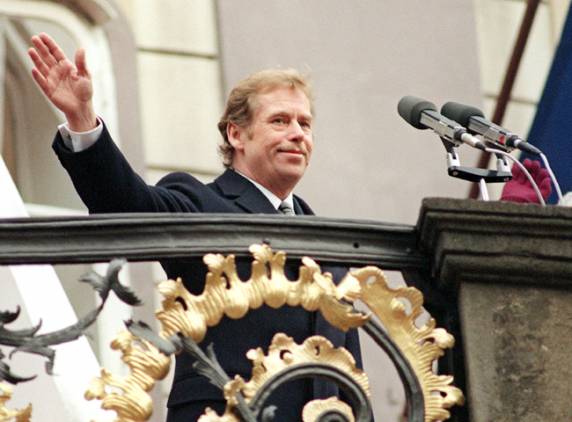
Zephaniah 3:14-20
14 Sing aloud, O daughter Zion;
shout, O Israel!
Rejoice and exult with all your heart,
O daughter Jerusalem!
15 The Lord has taken away the judgements against you,
he has turned away your enemies.
The king of Israel, the Lord, is in your midst;
you shall fear disaster no more.
16 On that day it shall be said to Jerusalem:
Do not fear, O Zion;
do not let your hands grow weak.
17 The Lord, your God, is in your midst,
a warrior who gives victory;
he will rejoice over you with gladness,
he will renew you in his love;
he will exult over you with loud singing
18 as on a day of festival.
even the by-ways of Scripture are precious
Zephaniah spoke as a prophet in the reign of Josiah (640-609BCE). This king was faithful to the One God but also led his people to a catastrophic defeat at the battle of Megiddo. This defeat raised questions about the prophetic theology that God would bless the people if the ruler was righteous. Zephaniah doesn’t really grapple with this issue, unlike for example, his successor, Jeremiah. He blames the people for their sins and prophesies more disaster at the hand of the Lord. Ultimately, however, all will be well: one day Jerusalem will be restored to freedom and prosperity. Oh yeah? But what about all those defeated and exiled generations? What about all those maimed or killed by the enemy? About them no word is said, other than the inexorable word of the Lord’s anger. Ultimately this theology says in God’s name: if you disobey me, you’ll be smashed; if you obey me, we can smash someone else.
Comments like these raise the question for me: why am I treating this material as Holy Scripture? Answer: it is part of the one book which bears witness to Jesus Christ. The steps on the way, the errors and wanderings of human understanding, are part of the story which tells us that only a suffering God can help.
Luke 1:1-25
1Since many have undertaken to set down an orderly account of the events that have been fulfilled among us, 2just as they were handed on to us by those who from the beginning were eyewitnesses and servants of the word, 3I too decided, after investigating everything carefully from the very first,* to write an orderly account for you, most excellent Theophilus, 4so that you may know the truth concerning the things about which you have been instructed. 5 In the days of King Herod of Judea, there was a priest named Zechariah, who belonged to the priestly order of Abijah. His wife was a descendant of Aaron, and her name was Elizabeth. 6Both of them were righteous before God, living blamelessly according to all the commandments and regulations of the Lord. 7But they had no children, because Elizabeth was barren, and both were getting on in years.
8 Once when he was serving as priest before God and his section was on duty, 9he was chosen by lot, according to the custom of the priesthood, to enter the sanctuary of the Lord and offer incense. 10Now at the time of the incense-offering, the whole assembly of the people was praying outside. 11Then there appeared to him an angel of the Lord, standing at the right side of the altar of incense. 12When Zechariah saw him, he was terrified; and fear overwhelmed him. 13But the angel said to him, ‘Do not be afraid, Zechariah, for your prayer has been heard. Your wife Elizabeth will bear you a son, and you will name him John. 14You will have joy and gladness, and many will rejoice at his birth, 15for he will be great in the sight of the Lord. He must never drink wine or strong drink; even before his birth he will be filled with the Holy Spirit. 16He will turn many of the people of Israel to the Lord their God. 17With the spirit and power of Elijah he will go before him, to turn the hearts of parents to their children, and the disobedient to the wisdom of the righteous, to make ready a people prepared for the Lord.’ 18Zechariah said to the angel, ‘How will I know that this is so? For I am an old man, and my wife is getting on in years.’ 19The angel replied, ‘I am Gabriel. I stand in the presence of God, and I have been sent to speak to you and to bring you this good news. 20But now, because you did not believe my words, which will be fulfilled in their time, you will become mute, unable to speak, until the day these things occur.’ 21 Meanwhile, the people were waiting for Zechariah, and wondered at his delay in the sanctuary. 22When he did come out, he could not speak to them, and they realized that he had seen a vision in the sanctuary. He kept motioning to them and remained unable to speak. 23When his time of service was ended, he went to his home. 24 After those days his wife Elizabeth conceived, and for five months she remained in seclusion. She said, 25‘This is what the Lord has done for me when he looked favourably on me and took away the disgrace I have endured among my people.’ 
Luke is a great kidder-an orderly account for Theophilus indeed! A profound, wonderful, imaginative fantasia on the doubtless sketchy history of Jesus’ birth would be a more accurate description. He’s a master craftsman, using the language of the Greek version of the Scriptures and weaving the themes of messianic prophecy into his narrative, creating characters and inter-relationships where probably none existed in his sources. All this is done in order to present an unforgettable theology of Jesus’ origin.
In this passage he begins by introducing his readers to John the Baptist, one-time prophetic rival of Jesus, whom all the gospel writers turn into a forerunner of the Christ. Luke links him to Jesus by family connection (Mary and Elizabeth are cousins) and by the unique divine planning which brings about their births. The mothers belong amongst pious poor people who long for the Messiah. In their different ways both stand for an ideal Israel awaiting the fulfilment of God’s promises. Elizabeth has been “barren”; as Israel has been in Luke’s eyes, but now, through God’s grace, those who have been barren become fruitful: “The Lord has taken away my disgrace”.
The message of this fruitfulness is itself “good news” or “glad tidings” which repeatedly is announced and repeatedly brings joy to those who hear and believe. Amongst the blessings of this good news is the marvellous phrase that it “will turn the hearts of parents towards their children” Of course, parents already love their children, but as God turns towards his people and life becomes fruitful, parents can see their own children as the promise of a renewed world. I wonder if this is possible for parents now. I hope so.
Vaclav Havel who died yesterday, should be remembered by the Christian Church for a theology that barely mentioned God, because it might be misunderstood, but which presented the One Beyond as the power of the powerless and as the truth which sets free. In the first summer after Czechoslovakian liberation I picked up two Czech hitchhikers in the Scottish highlands, medical students on their first trip abroad. When I said to them, “I admire your president,” they said instantly, “He is our hero. He stands for the Moral.” Havel exemplifies Luke’s story of powerless people finding a transcendent hope.
 Emmock's Blog