
This blog provides a meditation on the Episcopal daily readings along with a headline from world news:
Peruvian tribe tries to protect its children from the world

"uncontacted" Peruvian tribe
Genesis 22:1-18
The Command to Sacrifice Isaac
22After these things God tested Abraham. He said to him, ‘Abraham!’ And he said, ‘Here I am.’2He said, ‘Take your son, your only son Isaac, whom you love, and go to the land of Moriah, and offer him there as a burnt-offering on one of the mountains that I shall show you.’3So Abraham rose early in the morning, saddled his donkey, and took two of his young men with him, and his son Isaac; he cut the wood for the burnt-offering, and set out and went to the place in the distance that God had shown him.4On the third day Abraham looked up and saw the place far away.5Then Abraham said to his young men, ‘Stay here with the donkey; the boy and I will go over there; we will worship, and then we will come back to you.’6Abraham took the wood of the burnt-offering and laid it on his son Isaac, and he himself carried the fire and the knife. So the two of them walked on together.7Isaac said to his father Abraham, ‘Father!’ And he said, ‘Here I am, my son.’ He said, ‘The fire and the wood are here, but where is the lamb for a burnt-offering?’8Abraham said, ‘God himself will provide the lamb for a burnt-offering, my son.’ So the two of them walked on together.
9 When they came to the place that God had shown him, Abraham built an altar there and laid the wood in order. He bound his son Isaac, and laid him on the altar, on top of the wood.10Then Abraham reached out his hand and took the knife to kill* his son.11But the angel of the Lord called to him from heaven, and said, ‘Abraham, Abraham!’ And he said, ‘Here I am.’12He said, ‘Do not lay your hand on the boy or do anything to him; for now I know that you fear God, since you have not withheld your son, your only son, from me.’13And Abraham looked up and saw a ram, caught in a thicket by its horns. Abraham went and took the ram and offered it up as a burnt-offering instead of his son.14So Abraham called that place ‘The Lord will provide’;* as it is said to this day, ‘On the mount of the Lord it shall be provided.’*
15 The angel of the Lord called to Abraham a second time from heaven,16and said, ‘By myself I have sworn, says the Lord: Because you have done this, and have not withheld your son, your only son,17I will indeed bless you, and I will make your offspring as numerous as the stars of heaven and as the sand that is on the seashore. And your offspring shall possess the gate of their enemies,18and by your offspring shall all the nations of the earth gain blessing for themselves, because you have obeyed my voice.’
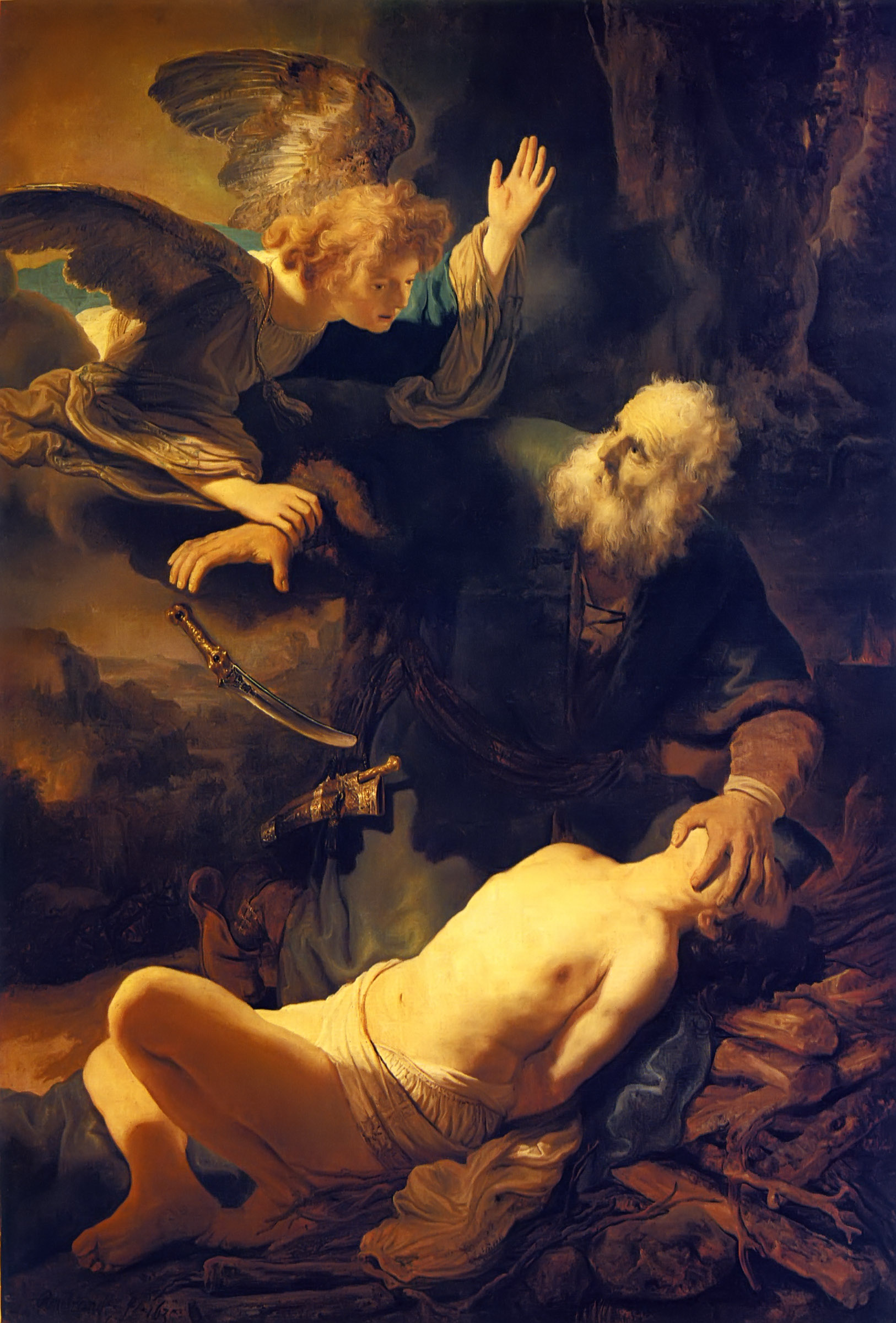 Bible commentators have struggled with this story for centuries. If it is taken as a story about an individual father and son it can only be horrific. Better surely have no God than a God who could commnd such a sacrifice. And yet…..the story is there. We can begin an interpretation by seeing it as the expression of Jewish experience over centuries. Their communal faith in God and his promise that against the odds they would remain a faithful people, depended on their children, amongst whom the first-born was of special importance. At the same time, that very same faith, demanding as it did obedience to the commands of a jealous God, put their national survival at risk, time and again. They were not to become militarised states like others or ally themselves with idolatrous great powers. They were to entrust their descendants to the care of a God who, they suspected, might let them perish, as He seemed to have done in the time of the Babylonian exile.
This contradiction of trusting in a God who makes promises about the offspring whose lives He puts at risk, is exactly depicted in the story of the “binding of Isaac”. It is a fundamental story about the passion and agony of Jewish faith: to hold to Jewish identity as commanded by God is to put your children at risk. Yes, God rescues Isaac but only just. Out of this passion for God comes the blessing, “Because you have not withheld your son, yor only son, from me, in blessing I will bless you…” God responds with an equal passion, which I believe is truly expressed only in the Christian revelation, where, as it were, God says, “Neither will I withhold my son, my only son, from you.” In this story we are very close to the heart of Jewish and Christian faith, to their shared and terrible history, in which those who believe God has given them his son have exterminated the sons of their Jewish neighbours, century after century, until now when Jewish people have taken up the habit of doing a bit of extermination themselves.
Recognising children as a gift from God while knowing that faithfulness to God may put them at risk, is a profound experience shared by many communities of faith.
John 6:52-59
52 The Jews then disputed among themselves, saying, ‘How can this man give us his flesh to eat?’53So Jesus said to them, ‘Very truly, I tell you, unless you eat the flesh of the Son of Man and drink his blood, you have no life in you.54Those who eat my flesh and drink my blood have eternal life, and I will raise them up on the last day;55for my flesh is true food and my blood is true drink.56Those who eat my flesh and drink my blood abide in me, and I in them.57Just as the living Father sent me, and I live because of the Father, so whoever eats me will live because of me.58This is the bread that came down from heaven, not like that which your ancestors ate, and they died. But the one who eats this bread will live for ever.’59He said these things while he was teaching in the synagogue at Capernaum.

In this image Rembrandt makes the angel bigger than Abraham
What does it mean to “eat the flesh of Jesus and drink his blood”? The traditional answer has been: it means sharing in holy communion. But seems a trivial interpretation of something that Jesus urges with such passion. Yesterday I suggested it means sharing the sacrificial generosity of Jesus which took him to the cross. We share it first of all as God’s love for us; but there is also an active sharing: those who will “live for ever” are those who are prepared out of love to pour their lives out. We’re back with Abraham aren’t we? The contradiction is just as much part of Christianity as it is of Judaism. Indeed it’s more sharply focused by Jesus: “those who try try to save their lives will lose them; but those who lose their lives for my sake and the gospel’s will save them.” If we had to arrange our own losses I guess most of us might never get around to it. But life is kind: it forces losses upon us and the way we cope with these expressess our real faith. Do we simply curse them and try to gain a position that insulates us from further loss; or do we learn from them how to love each other in a world of many losers? In a great play about Martin Luther, John Osborne has Luther say with reference to Abraham and Isaac, “In the teeth of life we seem to die; but God says No. In the teeth of death we live. If He butchers us, he makes us alive.”
 Emmock's Blog