
This blog provides a meditation on the Episcopal daily readings along with a headline from world news:
Egyptian Football Riot planned by political groups? 
Genesis 23:1-20
Sarah’s Death and Burial
23Sarah lived for one hundred and twenty-seven years; this was the length of Sarah’s life.2And Sarah died at Kiriath-arba (that is, Hebron) in the land of Canaan; and Abraham went in to mourn for Sarah and to weep for her.3Abraham rose up from beside his dead, and said to the Hittites,4‘I am a stranger and an alien residing among you; give me property among you for a burying-place, so that I may bury my dead out of my sight.’5The Hittites answered Abraham,6‘Hear us, my lord; you are a mighty prince among us. Bury your dead in the choicest of our burial places; none of us will withhold from you any burial ground for burying your dead.’7Abraham rose and bowed to the Hittites, the people of the land.8He said to them, ‘If you are willing that I should bury my dead out of my sight, hear me, and entreat for me Ephron son of Zohar,9so that he may give me the cave of Machpelah, which he owns; it is at the end of his field. For the full price let him give it to me in your presence as a possession for a burying-place.’10Now Ephron was sitting among the Hittites; and Ephron the Hittite answered Abraham in the hearing of the Hittites, of all who went in at the gate of his city,11‘No, my lord, hear me; I give you the field, and I give you the cave that is in it; in the presence of my people I give it to you; bury your dead.’12Then Abraham bowed down before the people of the land.13He said to Ephron in the hearing of the people of the land, ‘If you only will listen to me! I will give the price of the field; accept it from me, so that I may bury my dead there.’14Ephron answered Abraham,15‘My lord, listen to me; a piece of land worth four hundred shekels of silver—what is that between you and me? Bury your dead.’16Abraham agreed with Ephron; and Abraham weighed out for Ephron the silver that he had named in the hearing of the Hittites, four hundred shekels of silver, according to the weights current among the merchants.
17 So the field of Ephron in Machpelah, which was to the east of Mamre, the field with the cave that was in it and all the trees that were in the field, throughout its whole area, passed18to Abraham as a possession in the presence of the Hittites, in the presence of all who went in at the gate of his city.19After this, Abraham buried Sarah his wife in the cave of the field of Machpelah facing Mamre (that is, Hebron) in the land of Canaan.20The field and the cave that is in it passed from the Hittites into Abraham’s possession as a burying-place.
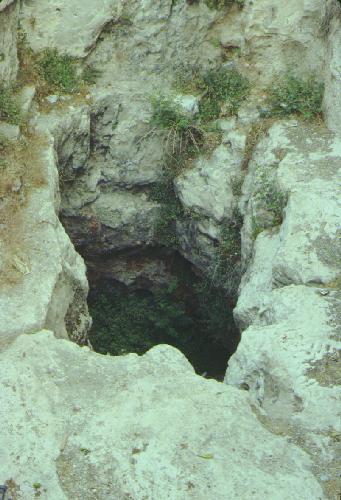
Tomb of the Partriarchs: Machpelah
This story reflects the customs of the culture in which it is set. Abraham, a considerable figure, albeit an alien in land occupied bu Hittites, is offered free burial space for Sarah, but he chooses to pay so that the land is his by right. This tradition establishes Canaan as the true land of God’s promise, which will ultimately belong to Israel. The negotiation with Ephron preserves ancient courtesies, whereby the buyer asks and the seller gives. The tomb of the partriarchs was doubtless held in honour much later in the history of Israel. The story is told, as indeed is the cycle of stories about the partriarchs, to indicate not only the antiquity of Israel’s right to the land, but also the patient purposes of God in forming a people who would be witnesses to his goodness. Often like Abraham, we find that a lifetime is too short for us discern the real value of our lives and we must simply act on the faith we have and the goodness we know, as he did.
John 8:31-36
True Disciples
31 Then Jesus said to the Jews who had believed in him, ‘If you continue in my word, you are truly my disciples;32and you will know the truth, and the truth will make you free.’33They answered him, ‘We are descendants of Abraham and have never been slaves to anyone. What do you mean by saying, “You will be made free”?’
34 Jesus answered them, ‘Very truly, I tell you, everyone who commits sin is a slave.35The slave does not have a permanent place in the household; the son has a place there for ever.36So if the Son makes you free, you will be free indeed. 
Jesus’ strong words puncture the comfortable faith of his contemporaries, who see themselves as children of Abraham, in God’s household. On the contrary Jesus tells them, they are slaves who may have no lasting place in God’s household. Only the son who is utterly obedient to God has a lasting place with God, only he can unveil the reality of God, and set people free from lies and sin as children of God. A true “descendant” of Abraham is one who like him, learns how to trust the true God. The utter certainty Jesus shows in John’s gospel is expressed more bluntly than in the other gospels.The change may reflect the dogmatic faith of the Christian community in which this gospel was written. The claim of Jesus to be a unique revelation of God’s truth is disturbing only if we think of it as a claim to personal power or exclusive truth. In fact Jesus claims only the vulnerability of love and includes the whole world in God’s invitation to be children in his household.

