
This blog provides a meditation on the Episcopal daily readings along with a headline from world news:
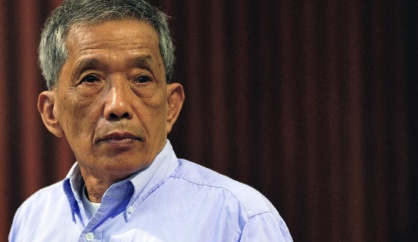
Khmer Rouge Mass Murderer given life sentence 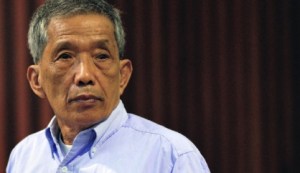
Genesis 24:1-27
The Marriage of Isaac and Rebekah
24Now Abraham was old, well advanced in years; and the Lord had blessed Abraham in all things.2Abraham said to his servant, the oldest of his house, who had charge of all that he had, ‘Put your hand under my thigh3and I will make you swear by the Lord, the God of heaven and earth, that you will not get a wife for my son from the daughters of the Canaanites, among whom I live,4but will go to my country and to my kindred and get a wife for my son Isaac.’5The servant said to him, ‘Perhaps the woman may not be willing to follow me to this land; must I then take your son back to the land from which you came?’6Abraham said to him, ‘See to it that you do not take my son back there.7The Lord, the God of heaven, who took me from my father’s house and from the land of my birth, and who spoke to me and swore to me, “To your offspring I will give this land”, he will send his angel before you; you shall take a wife for my son from there.8But if the woman is not willing to follow you, then you will be free from this oath of mine; only you must not take my son back there.’9So the servant put his hand under the thigh of Abraham his master and swore to him concerning this matter.
10 Then the servant took ten of his master’s camels and departed, taking all kinds of choice gifts from his master; and he set out and went to Aram-naharaim, to the city of Nahor.11He made the camels kneel down outside the city by the well of water; it was towards evening, the time when women go out to draw water.12And he said, ‘O Lord, God of my master Abraham, please grant me success today and show steadfast love to my master Abraham.13I am standing here by the spring of water, and the daughters of the townspeople are coming out to draw water.14Let the girl to whom I shall say, “Please offer your jar that I may drink”, and who shall say, “Drink, and I will water your camels”—let her be the one whom you have appointed for your servant Isaac. By this I shall know that you have shown steadfast love to my master.’
15 Before he had finished speaking, there was Rebekah, who was born to Bethuel son of Milcah, the wife of Nahor, Abraham’s brother, coming out with her water-jar on her shoulder.16The girl was very fair to look upon, a virgin whom no man had known. She went down to the spring, filled her jar, and came up.17Then the servant ran to meet her and said, ‘Please let me sip a little water from your jar.’18‘Drink, my lord,’ she said, and quickly lowered her jar upon her hand and gave him a drink.19When she had finished giving him a drink, she said, ‘I will draw for your camels also, until they have finished drinking.’20So she quickly emptied her jar into the trough and ran again to the well to draw, and she drew for all his camels.21The man gazed at her in silence to learn whether or not the Lord had made his journey successful.
22 When the camels had finished drinking, the man took a gold nose-ring weighing a half-shekel, and two bracelets for her arms weighing ten gold shekels,23and said, ‘Tell me whose daughter you are. Is there room in your father’s house for us to spend the night?’24She said to him, ‘I am the daughter of Bethuel son of Milcah, whom she bore to Nahor.’25She added, ‘We have plenty of straw and fodder and a place to spend the night.’26The man bowed his head and worshipped the Lord27and said, ‘Blessed be the Lord, the God of my master Abraham, who has not forsaken his steadfast love and his faithfulness towards my master. As for me, the Lord has led me on the way to the house of my master’s kin.’
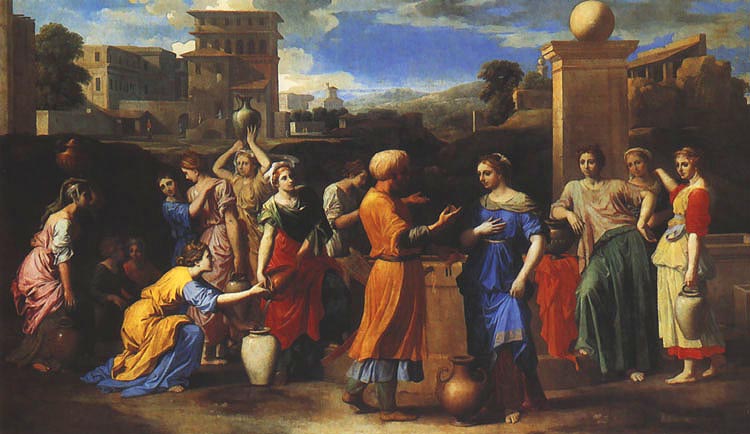 This is a beautiful story written in a style that suits the culture it depicts, emphasising human dignity and the faithfulness of God in events which are not dramatic but very important to Abraham, who has left his own land at the bidding of God, and now needs to find a wife for his son Isaac. Two possibilities are ruled out by Abraham’s faithfulness to God’s command: Isaac cannot take a wife from amongst the Canaanites; nor can he return to live in his family’s old lands. The motif of the man waiting by the well where women draw water is a lovely image of courtship which is used again in the Old Testament and also in the New, in the story of Jesus and the woman at the well. The woman who offers water to the man is symbolically offering hospitality and new life to the traveller. The traveller on his side offers respect to the woman and appreciation of her qualities, which in Rebekah’s case include a kindly and generous nature. Without any outward miracle the purposes of God are fulfilled through the adventurous goodness of human beings. Sometimes the life of faith is blessed by events like this.
John 7:1-13
The Unbelief of Jesus’ Brothers
7After this Jesus went about in Galilee. He did not wish* to go about in Judea because the Jews were looking for an opportunity to kill him.2Now the Jewish festival of Booths* was near.3So his brothers said to him, ‘Leave here and go to Judea so that your disciples also may see the works you are doing;4for no one who wants* to be widely known acts in secret. If you do these things, show yourself to the world.’5(For not even his brothers believed in him.)6Jesus said to them, ‘My time has not yet come, but your time is always here.7The world cannot hate you, but it hates me because I testify against it that its works are evil.8Go to the festival yourselves. I am not* going to this festival, for my time has not yet fully come.’9After saying this, he remained in Galilee.<!– 10 –>
Jesus at the Festival of Booths
10 But after his brothers had gone to the festival, then he also went, not publicly but as it were in secret.11The Jews were looking for him at the festival and saying, ‘Where is he?’12And there was considerable complaining about him among the crowds. While some were saying, ‘He is a good man’, others were saying, ‘No, he is deceiving the crowd.’13Yet no one would speak openly about him for fear of the Jews.
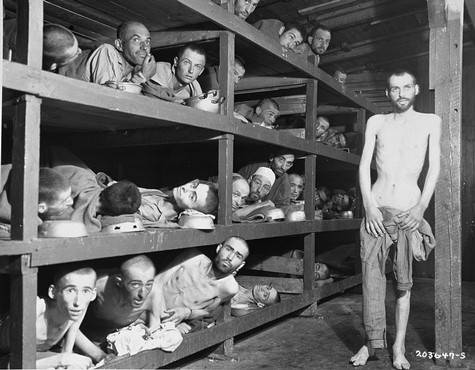
Jewish prisoners in Buchenwald
But sometimes the life of faith is like this. Jesus’ own brothers did not at this time believe in him, although this story depicts them as urging him to be more demonstrative in the Holy City of his people. Jesus seems to refuse, signalling that he will not peform miracles to order, but he later goes to the Festival of Shelters and publicly engages in disputation with the religious leaders of his people, who are opposed to him because he has healed a man on the Sabbath. This part of the story emphasises the disturbance of a religious community by new teaching and the cost to the one who brings such teaching. Indeed someone who from within a religious community challenges its basic assumptions will often be treated as a traitor deserving death.
This terrible intolerance has been demonstrated time and again within Christianity as well as other religions: the treatment of heretics, witches and reformers is evidence of this. John uses the Greek word “Iudaeoi”, Jews, to describe Jesus opponents, which may show that his Christian community viewed all Jews as enemies, which would be an instance of racial intolerance in Holy Scripture. It may be John’s word for a particular set of orthodox Jews. In either case its use for describing those responsible for Jesus’ death is wrong; it offered a pretext for Christian persecution of Jewish people right down to the Nazi Holocaust. It’s clear that a blanket condemnation of any people is utterly alien to Jesus who was himself a victim of religious prejudice.
 Emmock's Blog