This blog prvides a meditation on the Episcopal daily readings along with a headline from world news:
Red Cross unable to enter Homs to aid wounded 

Genesis 41:1-13
Joseph Interprets Pharaoh’s Dream
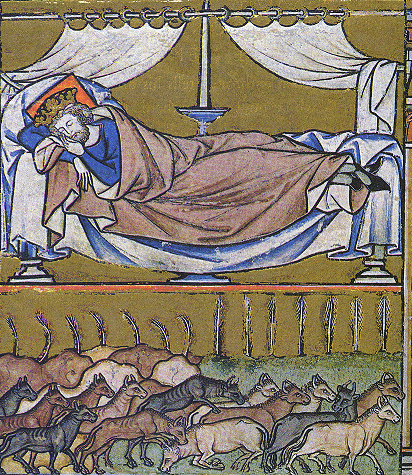
41After two whole years, Pharaoh dreamed that he was standing by the Nile,2and there came up out of the Nile seven sleek and fat cows, and they grazed in the reed grass.3Then seven other cows, ugly and thin, came up out of the Nile after them, and stood by the other cows on the bank of the Nile.4The ugly and thin cows ate up the seven sleek and fat cows. And Pharaoh awoke.5Then he fell asleep and dreamed a second time; seven ears of grain, plump and good, were growing on one stalk.6Then seven ears, thin and blighted by the east wind, sprouted after them.7The thin ears swallowed up the seven plump and full ears. Pharaoh awoke, and it was a dream.8In the morning his spirit was troubled; so he sent and called for all the magicians of Egypt and all its wise men. Pharaoh told them his dreams, but there was no one who could interpret them to Pharaoh.
9 Then the chief cupbearer said to Pharaoh, ‘I remember my faults today.10Once Pharaoh was angry with his servants, and put me and the chief baker in custody in the house of the captain of the guard.11We dreamed on the same night, he and I, each having a dream with its own meaning.12A young Hebrew was there with us, a servant of the captain of the guard. When we told him, he interpreted our dreams to us, giving an interpretation to each according to his dream.13As he interpreted to us, so it turned out; I was restored to my office, and the baker was hanged.’
The author of Genesis, one of the great storytellers of world literature, begins to reveal the improbable chain which links a dangerously dreamy Canaanite nomad to the most powerful man in the world: Pharaoh. The links of this chain have been built by human action and non-action but the chain itself is being dreamed by the author, who in turn presents it as God’s dream. If the cupbearer had remembered earlier his promise to Joseph perhaps the latter would have been freed into private service again, or allowed to return to Canaan, but through oversight he is still available to Pharaoh in his time of dreaming. The world of this story is the secular society of the ancient near east but it is interpenetrated by the dreams of men, who are both good and evil, and of God, who is only good.
 In comparison with this author, our ideas of faith are often crude, demanding special favours and miracles from God, rather than patiently discovering, like Joseph, how our deepest dreams are intermingled with the dreams of God, stretching our characters, like his, almost to breaking point.
Mark 2:23-3:6
Pronouncement about the Sabbath
23 One sabbath he was going through the cornfields; and as they made their way his disciples began to pluck heads of grain.24The Pharisees said to him, ‘Look, why are they doing what is not lawful on the sabbath?’25And he said to them, ‘Have you never read what David did when he and his companions were hungry and in need of food?26He entered the house of God, when Abiathar was high priest, and ate the bread of the Presence, which it is not lawful for any but the priests to eat, and he gave some to his companions.’27Then he said to them, ‘The sabbath was made for humankind, and not humankind for the sabbath;28so the Son of Man is lord even of the sabbath.’<!– 3 –>
The Man with a Withered Hand
3Again he entered the synagogue, and a man was there who had a withered hand.2They watched him to see whether he would cure him on the sabbath, so that they might accuse him.3And he said to the man who had the withered hand, ‘Come forward.’4Then he said to them, ‘Is it lawful to do good or to do harm on the sabbath, to save life or to kill?’ But they were silent.5He looked around at them with anger; he was grieved at their hardness of heart and said to the man, ‘Stretch out your hand.’ He stretched it out, and his hand was restored.6The Pharisees went out and immediately conspired with the Herodians against him, how to destroy him.

Stornoway Town Centre on the "Sabbath"
First the author has Jesus state a great principle, then he shows the principle in practice. Jesus says that the Sabbath Law is for the good of humanity, given as a gift, and should not be made into an imposition. God is not a tyrant who mkes rules for his own benefit but a wise ruler who gives them for his people’s welfare. This is a marvellous principle in Judaeo-Christian theology. God does nothing for God’s own mysterious benefit; he acts for the good of his creatures. In these words, Jesus invents/reveals a God who is different from the capricious tyrants of mythology who, like Homer’s deities or the God of the Flood, may act out of lust or rage. Jesus then goes on to show that the Sabbath, by restricting ordinary labour to a minimum, leaves space for the creative goodness of human beings (sons of men), in partnership with God, to save life. The first Christians observed the Jewish Shabbat as their day of rest and worshipped the resurrected Jesus on the first day of the working week, Sunday. By making Sunday the Christian day of rest and worship, the Christian Church lost contact with the Jewish institution, or, as in some reformed churches, attached the name of the Jewish day to the Christian Sunday, calling it The Sabbath. On the one hand, this has led to the abject surrender of the church to ecomomic power in the abolition of the Day of Rest, and on the other, to the bleak defiance of the world evident for example in some traditional presbyterian communities, where chained-up children’s play- parks are a visible image of the Pharisaical spirit which Jesus opposed. Those of us who out of a comfy liberalism ( I mean myself here!) have been complicit with the way of the world, are the more guilty; but we can repent by listening carefully to Jesus the Jew.

