This blog provides a meditation on the Episcopal daily readings along with a headline from world news:
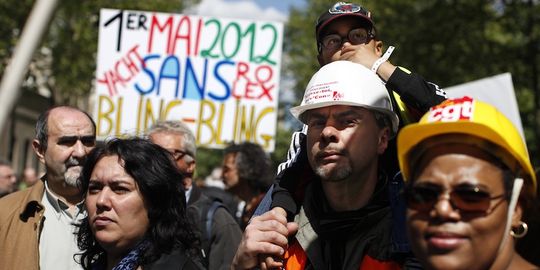
French Workers march for justice on May Day 
EXODUS 33: 7-23
7 Now Moses used to take the tent and pitch it outside the camp, far off from the camp; he called it the tent of meeting. And everyone who sought the Lord would go out to the tent of meeting, which was outside the camp.8Whenever Moses went out to the tent, all the people would rise and stand, each of them, at the entrance of their tents and watch Moses until he had gone into the tent.9When Moses entered the tent, the pillar of cloud would descend and stand at the entrance of the tent, and the Lord would speak with Moses.10When all the people saw the pillar of cloud standing at the entrance of the tent, all the people would rise and bow down, all of them, at the entrance of their tents.11Thus the Lord used to speak to Moses face to face, as one speaks to a friend. Then he would return to the camp; but his young assistant, Joshua son of Nun, would not leave the tent.
Moses’ Intercession
12 Moses said to the Lord, ‘See, you have said to me, “Bring up this people”; but you have not let me know whom you will send with me. Yet you have said, “I know you by name, and you have also found favour in my sight.”13Now if I have found favour in your sight, show me your ways, so that I may know you and find favour in your sight. Consider too that this nation is your people.’14He said, ‘My presence will go with you, and I will give you rest.’15And he said to him, ‘If your presence will not go, do not carry us up from here.16For how shall it be known that I have found favour in your sight, I and your people, unless you go with us? In this way, we shall be distinct, I and your people, from every people on the face of the earth.’
17 The Lord said to Moses, ‘I will do the very thing that you have asked; for you have found favour in my sight, and I know you by name.’18Moses said, ‘Show me your glory, I pray.’19And he said, ‘I will make all my goodness pass before you, and will proclaim before you the name, “The Lord”;* and I will be gracious to whom I will be gracious, and will show mercy on whom I will show mercy.20But’, he said, ‘you cannot see my face; for no one shall see me and live.’21And the Lord continued, ‘See, there is a place by me where you shall stand on the rock;22and while my glory passes by I will put you in a cleft of the rock, and I will cover you with my hand until I have passed by;23then I will take away my hand, and you shall see my back; but my face shall not be seen.’
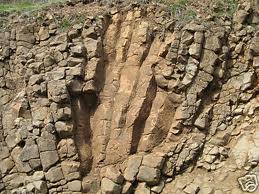
"I will take away my hand..."
This is one of the great chapters of biblical revelation. Firstly we have the moving account of Moses’ meetings with the Lord, in the tent which he set up for this purpose. It is said on the one hand, that God spoke to Moses face to face, as a friend, indicating an astonishing favour that the terrible God should accomodate himself to his human companion. Yet it is also said that the pillar of God’s presence “stands at the door of the tent” which indicates a distance between God and Moses. All those who have been schooled by the faith of Moses (amongst whom I number myself) know this baffling yet energising sense of intimacy and remoteness in their encounters with God.
Moses (and those schooled by him) does not use the privilege of access to God for personal meditation or improvement but to pray for God’s presence with his journeying people. If God will not go with us, what distinguishes us from any other people, he asks. It is not any worldly ability or moral superiority that distinguishes God’s people, but only the fact that they (in spite of their rebellions) are willing to journey with God and that God (in spite of their rebellions) is content to journey with them.
Finally we are given the wonderful moment of Moses’ request that God will show his glory to him. By the time of the final editing of this story, “glory” had become almost a technical term for God’s presence on earth. We suspect that in the original story Moses made a more direct request: let me see you. God replies gently that Moses will see all his goodness and will hear God proclaim the free gift of his kindness, but nobody can see his face and live. Indeed God himself will place Moses in a cleft in the rock and shelter him with his own hand from a sight which is too terrible for his humanity to bear. The darkness often experienced by believers is the shadow of God’s hand, the shadow in which Jesus cried out “My God, why?” When God removes his hand, Moses will see his back, but not his face. In the moment of revelation there is concealment; and in the moment after revelation all that can be seen is God’s back, the mere trace of his presence. That’s my own experience as a person of faith. There is no direct encounter with God but only the recognition that a certain condition of people or things is the aftermath of God’s presence, the consequence of his grace.
This great story is a better guide to an authentic spirituality than all the books that tell us how to breathe meditatively or how to enter the ebb and flow of the universe.
Matthew 5:17-20
The Law and the Prophets
17 ‘Do not think that I have come to abolish the law or the prophets; I have come not to abolish but to fulfil.18For truly I tell you, until heaven and earth pass away, not one letter,* not one stroke of a letter, will pass from the law until all is accomplished.19Therefore, whoever breaks* one of the least of these commandments, and teaches others to do the same, will be called least in the kingdom of heaven; but whoever does them and teaches them will be called great in the kingdom of heaven.20For I tell you, unless your righteousness exceeds that of the scribes and Pharisees, you will never enter the kingdom of heaven.
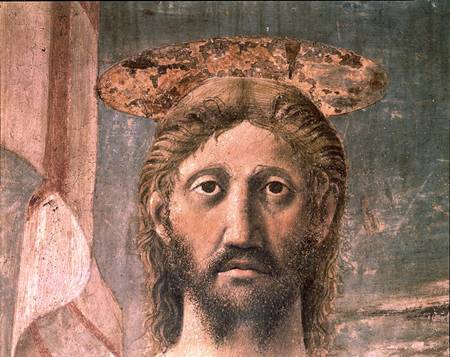
The glory of God in the face of Jesus Christ
Jesus knew his debt to the prophets and teachers of his people and was generous in his acknowledgement of them. He completely rejected the notion (which may have been curcnt in some early Christian groups, that his way was more permissive than that of the Pharisees. He stated that he had come to fulfil the law and the prophecies, not to abolish them. He meant that he would go beyond the commandments in revealing their true purpose and unlocking the secret of obedience to them; he would show the true face of the God who gave them; but he would not contradict them. We can see how Matthew reports Jesus as saying, “You have heard that they said…..but I say,” and in every case what follows is an intensification of the law. The righteousness of Jesus’ disciples must be greater than that of the Pharisees; love is more than justice but never less; the God of Jesus is forgiving but not careless.
 Emmock's Blog
You know that I enjoy your writing,so… I nominated you for the Reader Appreciation Award!!!
Congratulations! 🙂 -Faith