
This blog provides a meditation on the Episcopal daily readings along with a headline from world news:
Wild weather in UK
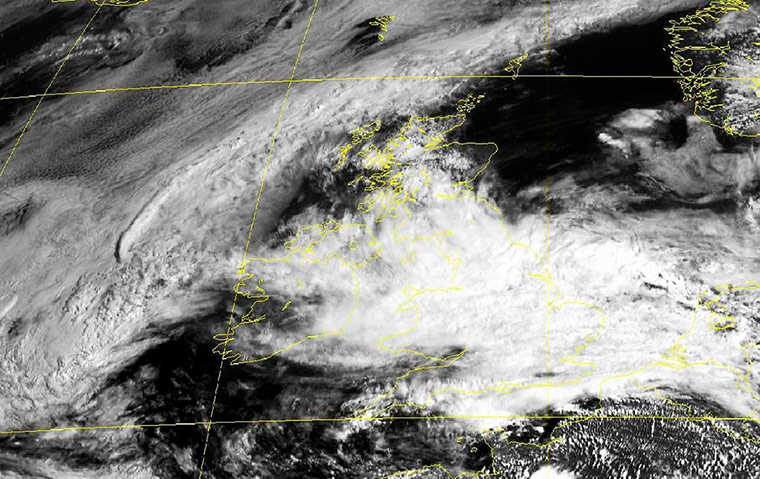
cloud system over UK
Romans 8:18-25
Future Glory
18 I consider that the sufferings of this present time are not worth comparing with the glory about to be revealed to us.19For the creation waits with eager longing for the revealing of the children of God;20for the creation was subjected to futility, not of its own will but by the will of the one who subjected it, in hope21that the creation itself will be set free from its bondage to decay and will obtain the freedom of the glory of the children of God.22We know that the whole creation has been groaning in labour pains until now;23and not only the creation, but we ourselves, who have the first fruits of the Spirit, groan inwardly while we wait for adoption, the redemption of our bodies.24For in* hope we were saved. Now hope that is seen is not hope. For who hopes* for what is seen?25But if we hope for what we do not see, we wait for it with patience.
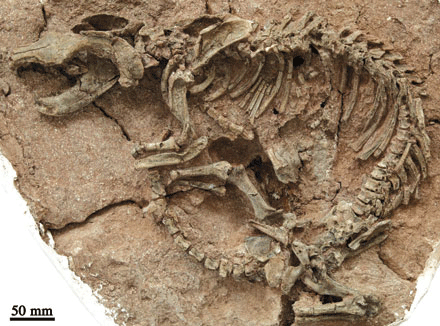
persishability-dinosaur fossil
It’s good to look at some of Paul’s vocabulary here:
eager longing: Paul’s Greek word means “looking with the head stretched forward”, depicting the attitude of one poised in expectation. We might say, “on tip-toe.”
futility: this is not a bad efort at Paul’s Greek. It’s the word used in Greek to tranlsate the Ecclesiates’, “vanity or emptiness”. Nothing in creation has lasting substance. Modern physics confirms this view.
bondage to decay: Paul’s Greek is quite sober: “slavery to “being perishable”.
The traditional vocabulary of English translations has intrduced an element of moral judgement on creation which is not present in Paul who simply emphasises its lack of self-identity and therefore its changeableness, all of which applies also to human life as part of creation. Paul interprets this “incompleteness” of creation as a sign of hope: everything is looking beyond itself towards a new future. This is in itself a profound interpretation and one that we can employ today.
But Paul has also heard the “groans” of creation. There is real suffering, not just of human life but of all life. Again he gives this an optimistic interpretation: creation is groaning in its labour-pains: something is being born. That something can be described as a new creation of which the exemplar is the “freedom of the glory of the children of God” Paul is adamant that we do not yet enjoy this: he is not carried off into a visionary denial of reality. Believers have received a share in the life of God through sharing the life of the community of believers, but they still suffer as they wait for their full adoption as children of God when their complete humanity will be set free.
Where does he get this faith?He sees the weakness/ suffering/ perishableness of Jesus Messiah on the cross as a loving participation by God in the “futility of creation”; and the resurrection of Jesus as a turning point whereby, in unity with him, all creation can move towards fulfillment. There is nothing in this masterly analysis which is anti-scientific; but rather it offers believers a basis on which to work out a theology of creation which is both more scientific and more profound than the pathetic creationism sometimes paraded as a Christian option.

