This blog offers a meditation on the Common Lectionary daily readings along witha headline form world news:
RED CROSS REPORT ON EUROPE SAYS ABSOLUTE POVERTY IS INCREASING

Rotherham Food Bank
Matthew 9:18-26
New English Translation (NET)
Restoration and Healing
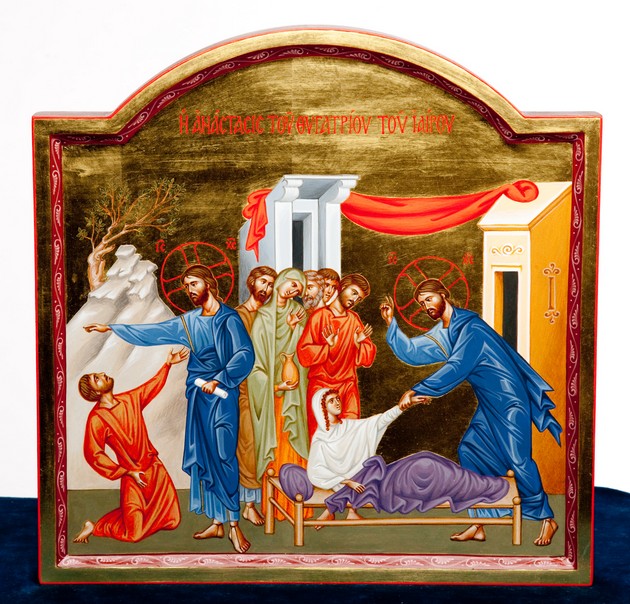
18 As he was saying these things, a ruler came, bowed low before him, and said, “My daughter has just died, but come and lay your hand on her and she will live.” 19 Jesus and his disciples got up and followed him. 20 But a woman who had been suffering from a haemorrhage for twelve years came up behind him and touched the edge of his cloak. 21 For she kept saying to herself, “If only I touch his cloak, I will be healed.” 22 But when Jesus turned and saw her he said, “Have courage, daughter! Your faith has made you well.” And the woman was healed from that hour. 23 When Jesus entered the ruler’s house and saw the flute players and the disorderly crowd, 24 he said, “Go away, for the girl is not dead but asleep.” And they began making fun of him. 25 But when the crowd had been put outside, he went in and gently took her by the hand, and the girl got up. 26 And the news of this spread throughout that region.
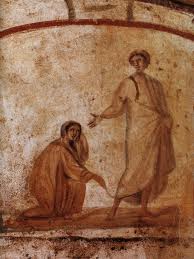
4th century image of woman touching Jesus’ cloak
In Mark’s gospel (6: 21-41) these two stories, the one nested in the other, are good examples of the writer’s skill: there are little details that create the drama;, the man is named as Jairus, his daughter is on “point of death” which gives point to his request, the woman has spent all he money on doctors but without a cure, she comes forward to Jesus trembling, Jesus’ words to the girl are reported in Aramaic, “Talitha Koum”, and so on. Again, as we have seen in the last few blogs, Matthew edits the drama from the narrative, leaving just the record of Jesus’ persistent, compassionate healing. He is telling the reader that all sorts and conditions of people are healed by Jesus, even those who suffer from taboo conditions, like menstrual ailments or have slipped into the zone of death. Mark’s depiction of Jesus as the bodily presence of God’s liberation disguises to some extent that the man claimed to be Son of God is performing tiny miracles in the backwater of a Roman province. For Matthew, the social ordinariness of the context of the healings and of those healed, is just the point. Amongst the disadvantaged of his society, in this case, women, Jesus challenges the heard-heartedness that accepts their illness. As he does so, he does not demonstrate a power such as only he may exercise, but rather the invincible gentleness of one human being open to another’s pain. This is the “power that God has given to human beings.” (Matthew 9:8)